
By Tom Champeau, Pisgah Chapter of Trout Unlimited
The Davidson River flows 15 miles through Transylvania County to the French Broad River and has been rated as one of the best trout fisheries in the Southeast. The river and its tributaries offer every option for anglers; native brook trout in headwater streams, blue line fishing for wild rainbow and brown trout, and hatchery-supported fishing downstream. Reports of fish over 20 inches long support the reputation of this fishery.
Flowing along Highway 276 in the Pisgah National Forest, the river affords easy and almost unlimited public access, drawing thousands of anglers, tubers, and swimmers. Fishing pressure is very high and regular stockings by the North Carolina Wildlife Resources Commission (NCWRC) help maintain satisfactory angler catch rates. Stocking has a long history in the Davidson as ruins from an old fish hatchery can be found near the upper end of the river at Daniel Ridge. Since 1983, NCWRC has operated the Bobby N. Setzer Fish Hatchery that was originally build in the 1960’s by the United States Fish and Wildlife Service. This hatchery produces about 60% of all trout stocked in North Carolina and will be closed for two years during a total reconstruction project that began in January 2026.
The reputation of the Davidson as a premier fishery is primarily due to having most of the watershed within the national forest that allowed aquatic habitats to recover from previous devastation. Brook trout were impacted by unmanaged timber harvest during the late 19th and early 20th centuries. The channel was modified to float logs downstream to a mill that existed near Sycamore Flats Recreation Area, and cobble was removed from the stream bed for road/railway construction. Habitat impacts and the introduction of rainbow and brown trout over one hundred years ago displaced brook trout from the main stem of the river, limiting their distribution to higher tributaries. For decades, discharge from the hatchery rich in nutrients and fish food along with high stocking rates produced many trophy-sized fish, helping establish the river’s reputation.
The future of the Davidson River as a premier fishery is not certain. While past impacts of poor timber harvest are long gone, current challenges of sedimentation from erosion of Forest Service roads and trails, extremely high use of the forest by anglers, hikers, bikers, and equestrians, a well-documented trend of warmer summertime water temperatures, and more-frequent high rainfall events with damaging floods must be addressed. Organizations such as the Pisgah Conservancy, Trout Unlimited (TU), Mountain True, Southern Off-Road Bicycle Association, Back County Horsemen of Pisgah, and others work closely with United States Forest Service staff to develop management plans and projects to protect forest resources while maintaining sustainable uses. Such a complex challenge does not always achieve stakeholder consensus, but having most of the Davidson River watershed within public land management provides for public engagement in the process.
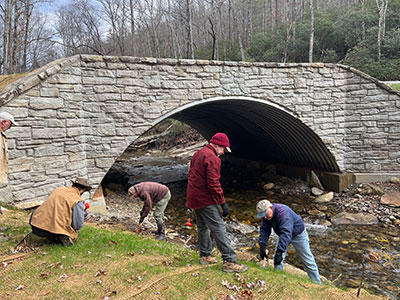
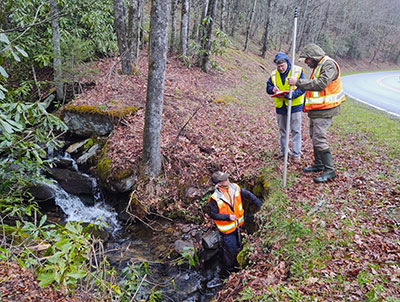
The Pisgah Chapter of Trout Unlimited (PCTU) made the Davidson River a conservation priority over 20 years ago with a formal partnership with the Forest Service. PCTU volunteers have provided thousands of hours to improve angler access and reduce erosion, conduct surveys throughout the watershed to document sedimentation sources and barriers to fish passage. Data collected during these surveys helped develop TU’s 2021 Sky Island Coldwater Conservation Plan and the Forest Service’s Watershed Restoration Action Plans that identify current projects. With federal funding from the Infrastructure Bill, the Inflation Reduction Act, and FEMA following flooding from tropical storms Fred (2021) and Helene (2024), many projects are underway and will occur to reduce sedimentation, remove barriers to fish passage, and improve aquatic habitat.
The Forest Service conducted detailed stream habitat surveys in 2003 and 2017 that documented habitat changes that concerned fisheries biologists. During the 14 years from 2003, the 2017 survey revealed a reduction in deeper runs and pools with increases in shallow riffle, increased exposed bedrock, and a decrease in large woody debris all pointing to lower quality habitat for trout. In 2020, TU led an effort with the Forest Service and other partners to create two sites of glide and pool habitat just downstream of the hatchery. These types of projects reverse incised channelization, reconnect floodplains, reduce riparian damage from future floods, and provide more diverse habitat for trout, hellbenders, and other aquatic life.
Following tropical storms Fred and Helene, damage to bank vegetation including the loss of mature trees was severe and shifted massive amounts of rock and cobble. The impacts of these habitat changes have yet to be determined, and repeating the detailed survey last conducted in 2017 would be helpful to evaluate the extent to these changes. For the past three years, PCTU volunteers have conducted biannual surveys of the Davidson to map impacts such as new and expanded cobble bars, landslides, log jams, and other changes. While not at the level of detail as those previously done by the Forest Service, data from these surveys help identify current threats to aquatic habitat. PCTU also spearheaded benthic macroinvertebrate surveys in 2002 and 2016 and is working with the Forest Service and Clemson University to repeat this work in 2027 to document the status of benthos since Fred and Helene.
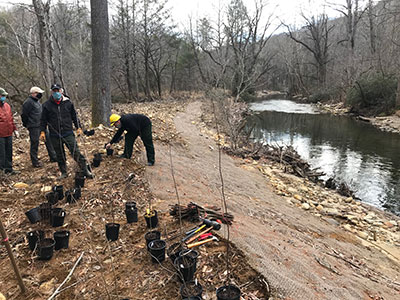
The Forest Service and NCWRC have restored brook trout populations within higher streams in the Davidson River watershed with additional projects underway. To inform this work and also document water temperature changes in the river, PCTU volunteers have installed loggers that record hourly readings. Logger sites are visited every six months to download temperature data that are sent to NCWRC for analysis. These data will document how increasingly warmer summers are impacting available trout habitat in Davidson River headwaters and tributaries.
The USGS gaging station located downstream of Sycamore Flats has recorded water temperatures since 2023, and over the past three summers daytime temperatures over 70 degrees have persisted from June through August. If higher water temperatures in the Hatchery Supported section of the Davidson continue in the future, NCWRC may have to revise its stocking strategy for the lower river. The logger project will inform fisheries biologists about which tributaries best provide thermal refugia for trout during summer and indicate future mitigation projects such as tree planting to increase the shade canopy over important streams.
The threats to the Davidson River’s trout fishery are very concerning and complex, but not unique in western North Carolina. The level of public involvement, cooperation and collaboration between stakeholder organizations and governmental agencies, and current availability of funding together provide hope that managing multiple uses and mitigating the impacts of climate change can be achieved. Projects underway to conserve cold-water habitat, manage trout fisheries, and restore brook trout and other endangered biota such as hellbenders in the Davidson will serve as examples for other river systems throughout the Southeast and across the country.