By Stanley Ray
I wake up, roll over, and glance at the clock. It reads 5:30 A.M. The bed is so comfortable and warm that I immediately start praying it’s raining outside. I love early-morning fishing, but some days the effort it takes just to get out of bed is enough to defeat me.
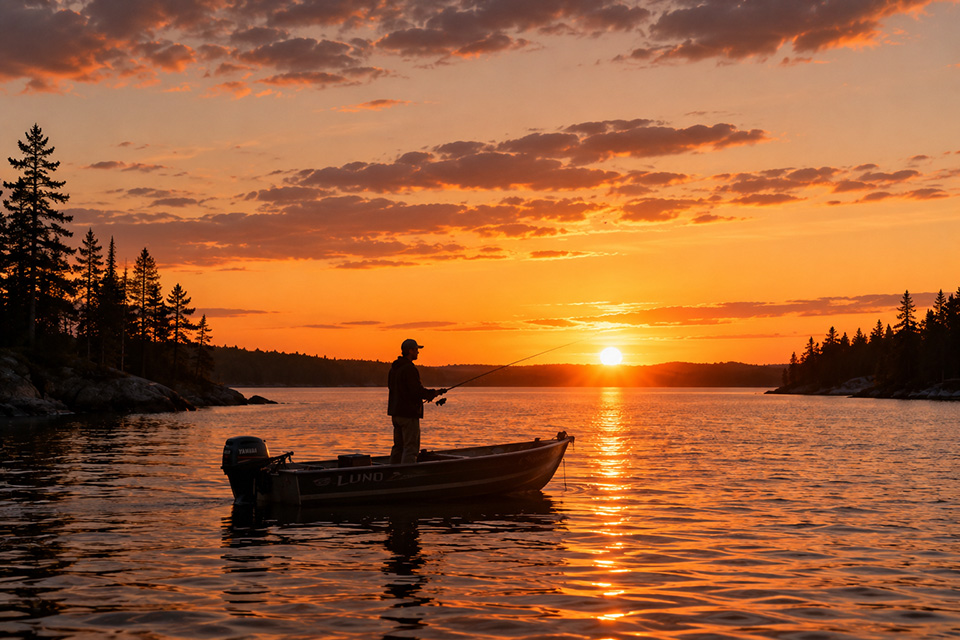
I drag myself to the cabin’s kitchen, cursing the fact I forgot to set the coffee maker, and look out the window. A spectacular sunrise greets me. Golden light spills across the mirror-calm Canadian lake, turning the water into liquid fire while mist rises like whispered prayers into a sky painted in rose, amber, and sapphire.
Minutes later I’m out the door, loaded down with two fishing rods, a net, a large tackle box, and a bucket of bait. The cabin sits high on the hill, offering a perfect view of the lake. Unfortunately the luxury of a perfect view also means a long trek down to the boat. I decide to carry everything in one trip rather than make two.
As I lower myself onto the foldable seat, I suddenly remember the heavy dew that gathers all night. Of course, I sit directly in a cold puddle of it. The sickening feeling hits instantly — it’s too late to do anything about it.
I brush the overnight cobwebs off the motor handle. Being electric, I’m spared the familiar morning struggle of yanking the pull cord like I’m starting my old lawn mower. The motor coughs to life, shattering the profound silence of the still lake with a low, guttural rumble that echoes across the water. Ripples race outward from the boat. The glassy mirror that had perfectly reflected the fiery sunrise just moments before is now a series of ripples racing from the boat. I point the bow toward the space between Spook and Black Island, where the weeds are scattered and the walleye are hungry.
It’s one of those perfect mornings on the lake with no drift at all. I have time to ease along the edge of the weeds and cast my favorite lure. My line peels off the reel in lazy, slightly drunken spirals. The motion reminds me of the way smoke used to drift up from my father’s cigarette while he sat fishing with a patience I never quite understood as a child. I toss out the old green “perchie” Beno crankbait with the white belly. That lure has seen more underwater drama than Jacques Cousteau. It kisses the surface with a soft, satisfying plop. Perfect concentric circles ripple outward. They look peaceful and innocent until you realize they’re quietly hanging up a sign that says “Free Breakfast” to anything with fins and questionable judgment.
I usually let the Beno sink three or four seconds to give the fish time to consider its options. It’s barely dawn and I know the walleye are up in the weeds. I begin to turn the handle of the old Mitchell reel my father handed down to me. Then it comes — a soft, rhythmic dance at the tip of my rod. I set the hook, only to find out that perch will also hit early in the morning… small perch.
I repeat the sequence time after time, cast after cast, in a steady, almost meditative rhythm. Each cast pulls me deeper into the moment, quieting the noise in my head and reminding me that peace can be found in the simplest things. It’s about the closest thing I’ve found to church that doesn’t require fighting for a parking space or listening to someone sing slightly off-key about how much Jesus loves me.
Then my mind drifts back to the time my father first taught me how to fish.
The two of us would sit in the breaking sunrise. I had no idea he was running a covert seminary aboard a fourteen-foot wooden boat, the two of us drifting together in a happy silence.
Fishing, he was trying to show me, is nothing more than a long, patient commentary on life. A walleye’s bite, he taught me, can come in three ways. Sometimes it arrives so softly you barely notice it — just a gentle tap as the fish pokes and prods the bait, trying to decide if it wants a meal. Other times it comes as a nibble, a little more insistent. Who knows why — maybe it’s testing its courage, or maybe it’s simply hungry enough to take a chance. And then there are the moments when the universe seems to hold its breath in a split-second hesitation, right before the fish decides whether to run with you or run the other way.
Sitting on the lake today, I realize dad was teaching me that fishing is far more than a hobby — it is a quiet, patient metaphor for life itself. Just as a walleye’s bite can arrive in three distinct ways, so too do the opportunities and defining moments of our lives. Some tap so gently we almost dismiss them as nothing important and move on. Others nibble cautiously, inviting us to play with the possibility before we decide whether to commit. And then there are those rare, electric moments when the universe seems to pause, holding its breath. These are the times where we choose whether to run with the chance or let it slip away forever. My father wasn’t just teaching me how to catch walleye on a still Canadian lake. He was teaching me how to recognize and respond to life when it finally decides to bite.
The real kicker? Twenty years later I’m still out here doing the exact same thing—except now I’m dropping eight hundred dollars on new gear to catch the same fish Dad used to land with a rusty Mepps Spinner and a quiet prayer. Funny how the fish never change, but the price of the memories is worth every penny.
My reverie shatters and I am brought back to the present. The weed I thought was on my line suddenly comes to life, far more animated than any clump of vegetation has a right to be. The fight is on. The walleye surges hard toward the bottom, stripping line in sharp, angry bursts. My rod bends deeply in a smooth, throbbing arc as I lean back and keep steady pressure, the reel singing its high-pitched protest with every run. Then come the signature head shakes — violent, side-to-side thumps that travel up the line like Morse code. I gain a few feet, only for the fish to turn and bolt again, flashing its golden flank just beneath the surface. My heart pounds in rhythm with the rod. This isn’t a frantic, acrobatic battle like a bass; it’s a stubborn, powerful tug-of-war. The walleye uses every inch of its broad body to outsmart me. For a long minute it feels like we’re evenly matched — man and fish locked in a silent, breathless conversation on opposite ends of the line.
One brief sweep of the net and the battle is over. I lift what I was sure would be a lunker into the boat, only to be greeted by what my father used to call a “hammer-handle.” This is what he referred to as a walleye ten inches or less. Apparently I didn’t have my drag set properly. Nevertheless, I bring the walleye into the boat and pause, just admiring it for a moment. Its golden flanks glow in the early sunlight, each scale shimmering like polished bronze. Its eyes stare back with an almost prehistoric calm. With careful hands I cradle the fish, gently working the hooks of the crankbait free from its jaw. No unnecessary force — just quiet respect for a worthy opponent.
And then I do what all fishermen do but rarely admit. When I’m sure no one is around to witness my foolishness, I hold it up to my face and whisper, “Grow up and come back when you’re bigger.” I will testify that if any serious fisherman ever claims he has never had a private conversation with a fish he was about to release, I am calling him a liar in the gentlest, most Christian way possible.
Then I cast again, and my mind drifts back to dad.
Dad never spelled any of it out loud. He didn’t need to. He just handed me the rod, lit another cigarette, and waited for the lesson to travel up the line and into my own two hands. The real education wasn’t in the catching. It was in learning to recognize the bite before it was gone—whether it came dressed as a fish, a friendship, a risk worth taking, or a regret you’d rather not drag up later. Set the hook, sport, he seemed to say without moving his lips. Life rarely announces itself with trumpets and drama. Most of the time it just gives you two quiet seconds of something that might be nothing at all.
And if you miss it? Well… worst case, you drag up a salad. But at least you’ll know you were paying attention.
After a hard day’s fishing, we’d putter back to the dock in that old wooden Peterborough boat. The five-horsepower motor hummed its steady, slightly asthmatic tune. We moved so slowly it reminded me that life itself often travels at its own unhurried pace. It was patience taught in the gentlest way possible.
The gentle golden light of morning slowly gives way to a high, brilliant noon sun. What began as a soft blush of rose and amber across the lake hardens into a sharp, white-gold blaze overhead, turning the water from liquid fire to a dazzling mirror that forces me to squint. Dad would tie-up the boat with the same deliberate care he brought to everything, then head to the boathouse, drop a Canadian quarter into the ancient soft-drink machine, and pull out two cold bottles: one Fanta root beer for him, dark and spicy and smelling like the old-fashioned candy store in town, and one Fanta grape for me, that bright purple pop that turned your tongue the color of royalty for the rest of the day.
He’d pry off the caps, hand me mine, and we’d sit there on the bench with our legs dangling. We sipped in companionable silence while we waited for Hank Albrecht, one of Dad’s police buddies, to come ashore. That root beer was his quiet reward for patience; my grape was the sweet payoff for not losing too many lures. We never talked much about the fish we’d caught or the ones that got away. The pop did the talking for us—cold, fizzy, and reliably sweet in a world that wasn’t always.
I have come to understand later that those ten minutes on the dock were the real sermon. Dad was showing me that the best parts of the day often arrive after the excitement fades: when the rods are put away and all that remains is the simple pleasure of something cold and familiar shared between two people. A father and son who don’t need to fill the quiet with words. Life, he seemed to say without saying, is mostly made of these small, repeatable rituals. They are the things you can count on even when the walleye won’t bite and the weeds fight back harder than they should.
Later that same morning we went out again and I snagged the mother of all weed beds. My lure buried itself so deep in the greenery I half expected to pull up a small sofa or last year’s lost dock cushion. My father had a name for this sort of thing: “catching the bottom of the lake.” He said it in the same resigned tone other men reserve for announcing their favorite college team lost out on a star recruit.
Dad was generous with his knowledge. He’d stand on the dock pointing out the good spots to total strangers, handing over lures like they were after-dinner mints. When I asked why he gave away our best fishing holes, he just smiled that quiet smile of his and said, “If everybody’s catching, the camp stays happy. A happy camp is a pleasant place to be.” I was young enough to be upset at the fact I thought he was giving away all of our best fishing holes. I’m old enough now to recognize fishing is not a zero sum game—a situation where if someone catches fish, others can catch them too. What do you expect? I was only ten.
For years, my mother, father, older sister, and brother made the annual trek to Canada. Dad was a firm believer in the sanctity of family, and he proved it every chance he got. My brother eventually stopped coming once he was old enough to stay home alone — fishing was never really his thing. He learned life’s lessons in his own way. For nearly forty years we had assigned seating in that boat: Dad at the motor, Mom up front with her thermos of coffee, and me in the middle like the bologna in a very slow-moving sandwich. When my sister joined us, she wedged in beside Mom and I was promoted to clean-up duty. My parents would hook the fish, then hand me the rod so I could feel like the hero of the moment. I lost far more fish than I landed, but they never once made me feel foolish. That, I’ve come to understand, was the entire curriculum.
I’m retired now. I used to teach history to teenagers who were fairly certain the world began the week TikTok was invented. I still try to pass along the same quiet lesson: slow down, look around, and let yourself fail spectacularly every once in a while. Life isn’t a Jeopardy! category you can study for. It’s mostly just existence—messy, beautiful, and occasionally full of weeds that refuse to let go.
I now sit on the lake in a bay my dad called “half-bay,” years after my father has passed. I recall these times while perusing my tackle box for just the right lure. The lake lies glass-calm, the kind of stillness that makes you feel as though the whole world has decided to hold its breath for a while. I pull out an orange Beno crankbait in honor of my mother, and right away I feel a small wave of guilt for every fish I’d ever caught on that particular lure while she was no longer with us. No matter. I could almost hear her laughing softly from somewhere beyond the pines, cheering me on the way she always did, her voice carrying across the water like it used to when she sat up front with her scarf blowing in the breeze.
The moment that lure touched the water, something monstrous and clearly in a bad mood inhaled it. The fight was glorious—the fish ran hard, dove deep, and did exactly what every fish does when it’s in trouble: it made a suicidal sprint for the motor and tried to gift-wrap my line around the prop.
My pole bent like it was deep in earnest prayer. When I finally slid the net under him, he looked every bit of six pounds: fat, furious, and deeply unimpressed with the general direction of my life choices up to that point.
I held him over the side, swishing him back and forth in the water the way my father taught me, reviving him gently. “This one’s for you, Dad,” I said quietly as I let him go. For a second I swear I could see him there in the back of the boat, cigarette glowing, grinning like he’d just witnessed the greatest showdown between man and fish he’d ever seen.
Because that’s what he did best. He taught me how to fish, how to sit quietly with the sunrise, how to share your good spots with others, and—in the true spirit of a fisherman—how to pull off the occasional harmless prank when no one was looking, like quietly swapping another man’s stringer of fat walleye for a bloated, half-rotten sucker.
Fishing metaphors endure because they are tactile and universal. They capture the mix of hope and disappointment, skill and luck, solitude and connection that define so much of life. Whether in epic struggle, whimsical critique, or intimate epiphany, they invite us all to slow down, pay attention to the line, and appreciate both the catch and the waiting.
Now fish on, friends. And try not to snag the bottom of the lake too often—that’s just the fish’s way of saying they’re not interested in your offering today.
That’s the news from the church on the lake, and make no mistake about it… it is a church. I love you, Dad.
Stanley Ray can be reached at StanleyKRay@aol.com