

By Tom Champeau, Pisgah Chapter of Trout Unlimited
With summer finally here, trout anglers enjoy getting out of hot waders to “wet wade.” During summer, aquatic insects are abundant and terrestrial insects like ants, hoppers, and inch worms provide a wide smorgasbord of fly options.
The North Carolina Wildlife Resources Commission stocks streams designated as Delayed Harvest through May and Hatchery Supported for much of the summer for those who seek easy access to fishing. Check with the NCWRC website for details on their stocking program at https://www.ncwildlife.gov/fishing. The Cherokee Tribal Fish Hatchery, operated by the Eastern Band of Cherokee Indians Natural Resources Department also stocks over 200 locations across Cherokee’s Qualla Boundary streams.
For those anglers who prefer fishing for wild rainbow and brown trout, or higher elevation streams for native brook trout, early summer offers the best fishing. Fish are hungry and the water is at ideal temperatures for trout activity. We love our trout and to be responsible anglers, we must pay close attention to water temperatures as summer progresses. One item that all trout anglers should have during summer is a thermometer.
All trout species in Western North Carolina become stressed as temperatures exceed 68 degrees. They become less active, consuming less food which slows growth rates. As temperatures move into the 70’s, mortality rates can increase with younger trout being most vulnerable. Thermal tolerance is dependent on literally thousands of proteins that drive trout’s cellular functions. Proteins are enzymes that fail to function outside their specific temperature ranges. Hooking and playing a trout in waters over 68 degrees maximizes stress levels which greatly increases mortality rates. Please follow the guidelines illustrated in the figure to keep fish healthy.
Over the past couple of decades, daytime temperatures in many rivers in our area have exceeded 68 degrees earlier in the summer. Data collected by the NCWRC at stocking sites have documented this trend. Fisheries managers have been forced to modify stocking locations and schedules due to high temperatures in some cases.
Western North Carolina has also been experiencing below average rainfall for several years despite what Hurricane Helene brought. River flows have been reduced and severe drought conditions so far this year are very concerning. Drought and low flows allow temperatures to rise faster.So, what are options for trout anglers as the summer progresses?
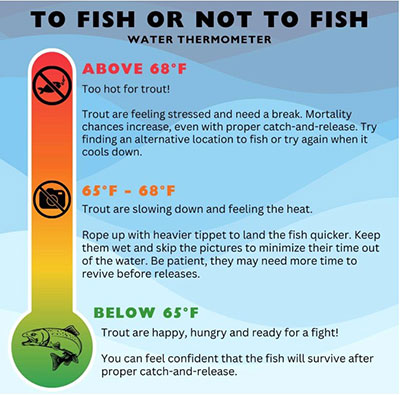 Anglers who practice catch-and-release may have to limit their fishing during the early morning hours. Overnight, most mountain streams cool below 68 degrees, however, many heat up again by early afternoon. Use a thermometer and your best ethical judgement. Whenever handling your fish, get them back into the water as fast as you can. Save photos for cooler months.
For those harvest-oriented anglers who like to fish stocked waters, taking home fish within legal limits is a good use of the resource that will likely die from heat stress anyway. Catch-and-release advocates probably are cringing and turning red reading this but providing a put-and-take fishery in a stream where summer temperatures cannot sustain a wild trout fishery is a valid management goal. Stocked trout do not survive very long in lower elevation streams that heat up into the mid to high 70’s during most summer days.
Wild trout anglers can usually find stream temperatures below 68 degrees at higher elevations, especially in tributaries with full tree canopies. It takes more effort to access these streams, but cooler temperatures and less chance of seeing other anglers make it worthwhile. Still measure the temperature before you fish as not all tributaries have the same thermal patterns.
To better understand which tributaries within a watershed stay cold over the summer and provide refugia for trout during the hottest periods, scientists and volunteers from many agencies and organizations are installing automatic temperature loggers in many sites across the Southern Appalachians. These devices record water temperatures every hour and store data for six months before having to be visited by scientists to download the data. This important information is critically important to identify tributaries that maintain ideal temperatures for trout and which ones experience stressful daytime heating. With a few seasons of data, a listing of streams that maintain temperatures suitable for daylong fishing could be available to anglers.
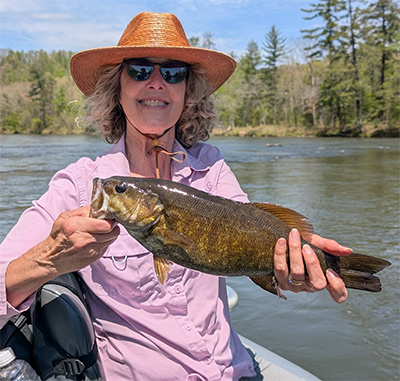
Another great option is to switch species such as smallmouth bass and panfish (redbreast, green, bluegill, pumpkinseed, and redear sunfish). Good riverine fisheries for these and other gamefish species are the French Broad, New, Tuckasegee, Little Tennessee, Nolichucky, and Cheoah. Some rivers have public access from the bank, but best success occurs when easing down the river in a float boat, canoe, or kayak. Many ponds and reservoirs support excellent cool and warmwater fisheries that can be best fished from a boat, although some offer bank fishing access.
 Casting small streamers near downed brush and root wads will tease feisty sunfish from their hiding places, and target smallies from their favorite structure such as rock piles, bedrock channels, and ledges. Smallmouth go for crayfish patterns, poppers, and streamers, and those opting for spinning gear do well with jigs, soft-bodied jerk baits, and plastic worms fished “Carolina-style.” Fishing is good from May through October and pound for pound, few fish fight harder than smallmouth bass.
So beat the heat of summer by exploring some higher trout streams or target bass and panfish in our larger rivers, ponds, and lakes. Stay hydrated and have a great summer!