By Captain Quinlyn Haddon
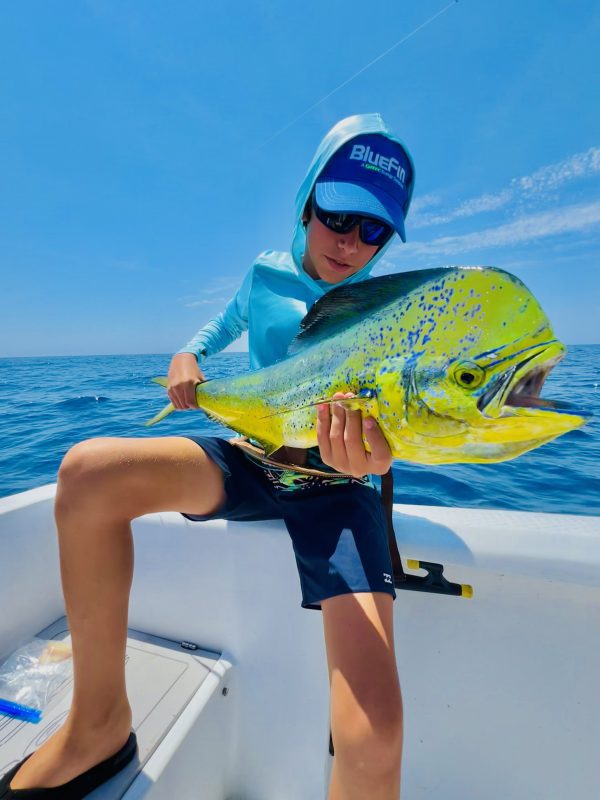
For new boat owners with a vessel and captain capable of getting offshore, targeting mahi is a great choice for first-timers who are wanting to push into the offshore fishery.
Mahi fishing doesn’t require any predetermined coordinates, and anyone can head out there and find them. Depending on your location and time of year, you can start looking for signs of life as shallow as 100’. This time of year in the Florida Keys, you may have your best luck past 500’.
As you make your way offshore, your hunt begins immediately. Your head should be on a swivel, scouring near and far for the telltale signs of mahi activity. Current edges, weedlines, debris, baitsprays, and diving birds found within the desired depths, are all worth checking out.
When you have found one of these potential mahi zones, you will initially troll the area, and then move into casting at the school once you have hooked up to a fish.
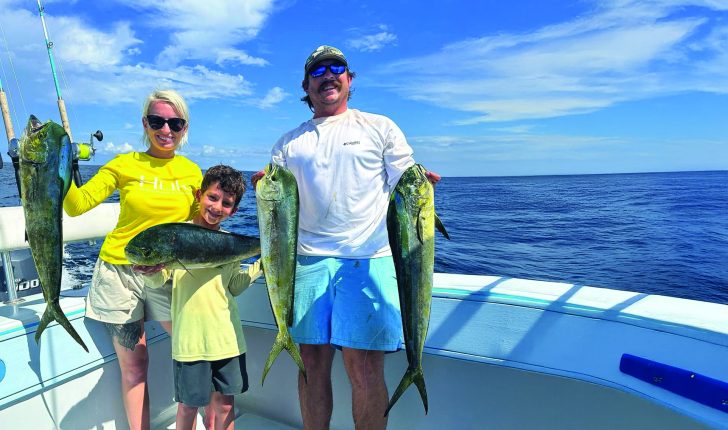
Depending on the set-up of your boat, you can get the job done trolling 2-5 lines. It really isn’t necessary to go overboard with a mahi spread as they have a tendency to tangle lines, and a majority of your catching will be done after you have hooked up to a single fish. Once you have hooked up on the troll, you will have to clear all the other lines to prepare for casting at the school. If you have too many lines to clear, you may miss your opportunity for multiple hookups during the initial feeding frenzy.
If you have outriggers, trolling 4 lines is pretty straightforward. If your riggers have dual clips, the highest set clip will hold your longer lines. If you only have single clips, use them for longer lines with rigged ballyhoo, and run two chuggers from the gunnels, set closer to the boat.
If you dont have outriggers, you can use shorter rods or bent-butts for short lines near the back of the boat, and run two longer lines from taller trolling rods, set behind them midship, or just keep it simple and run two or three lines.
The most important rule of setting a spread is that lures that dive deeper should be set as shorter lines, running closest to the boat, while lures that skip the surface will be your longest set lines. This gives you the ability to turn the boat without risking tangles. If your short chuggers are exactly the same, they can be run at identical lengths, otherwise, stagger them appropriately according to their weight and depth they run through the water.
If you want to run a fifth line down the center, you can choose a long line that increases your chances of catching tuna. This rod should be placed up high on the center of the boat in the rocket launcher and should have a very light lure that skips the surface. Alternatively, you can run it short from the transom, with a lure that dives deeper and increase your chances of catching wahoo.
If you opt for the short fifth line, be aware that running anything with treble hooks is not recommended for targeting mahi. Not only do they flip like rabid snakes when in the boat, but as they jump and shake when hooked, they can send that lure flying back at you if they are successful in freeing themselves. Choose a wahoo lure with single hooks if you are running this type of spread.
If you go with a long line as your fifth line, be mindful that you will likely catch more weeds this way. This is a better option in open water while trolling under birds rather than weedlines. It also makes it difficult to make tighter maneuvers. Always make wide turns, and speed up through them to keep the lines tight and maintaining the lure’s action.
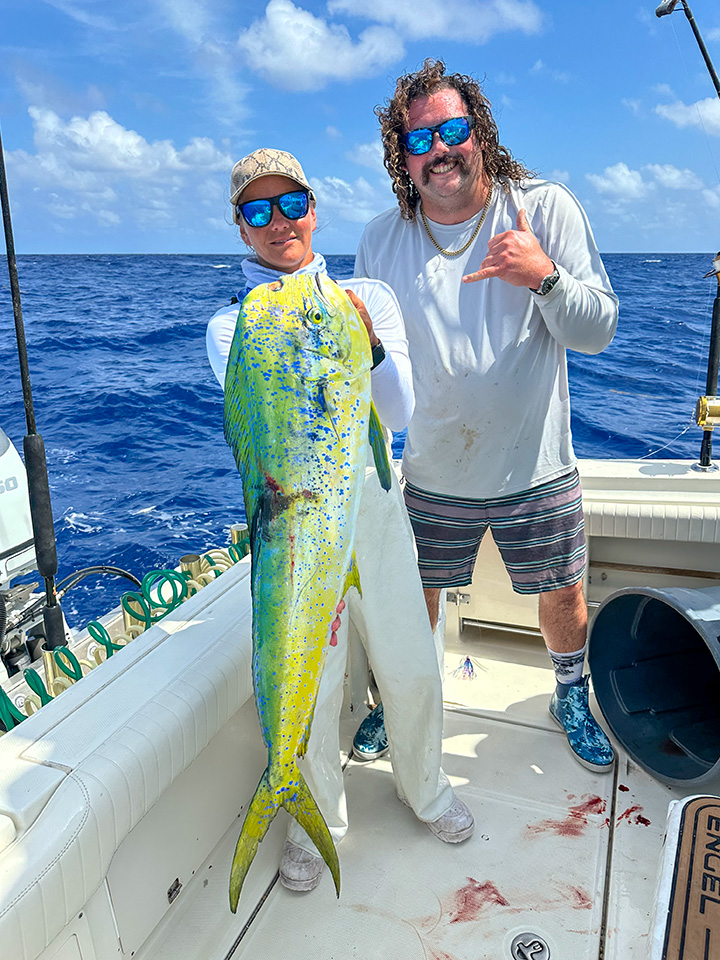
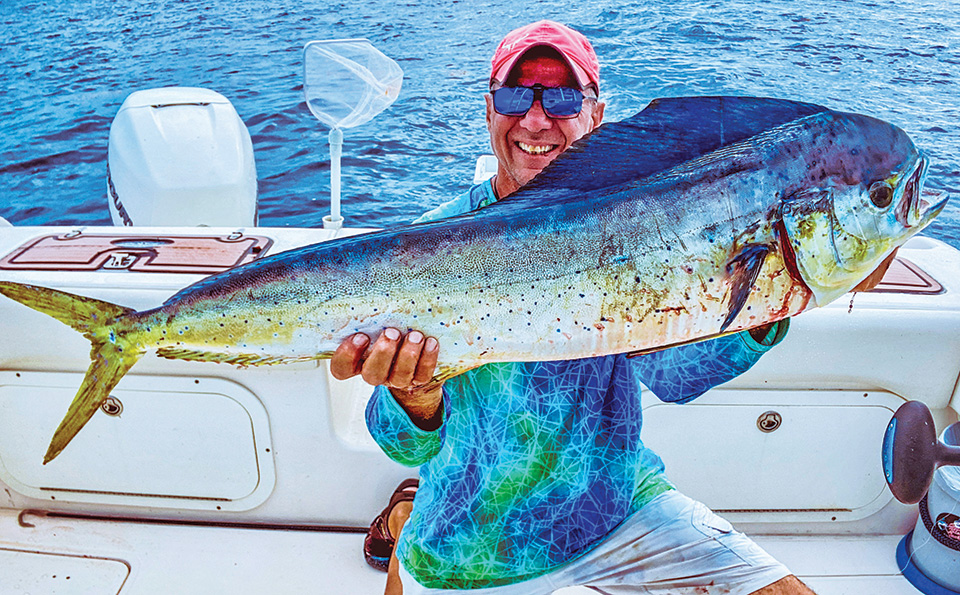
Once you have hooked into a mahi, slow the boat but keep it in gear while you clear the other trolling lines. Bring the hooked fish close to the boat, but leave it swimming in the water as it will act like a chumbag to bring his buddies up to casting range. Grab your spinning rods with 50-80# leader and an 8/0 j hook, toss on a live or chunk of bait and cast out behind the hooked fish. Let it drift back, occasionally stopping the line with your finger and giving it a little twitch and then continuing to free-line it back. When you get a bite, give the fish a few seconds to eat and then close your bail and reel. Once you have all your rods hooked up with fish, start taking them into the boat one at a time and casting back into the school, holding multiple hooked fish in the water as you start rotating them out.
If you aren’t quite ready to go this solo yet, give Sweet E’nuf Charters a call to book a mahi catching trip and we will teach you everything you need to know to make the mahi fear you.
Happy hunting!
—
-Captain Quinlyn Haddon
504-920-6342
IG: @CaptainQuinlyn
www.captainquinlyn.com
Sweet E’nuf Charters, Marathon, Florida Keys.