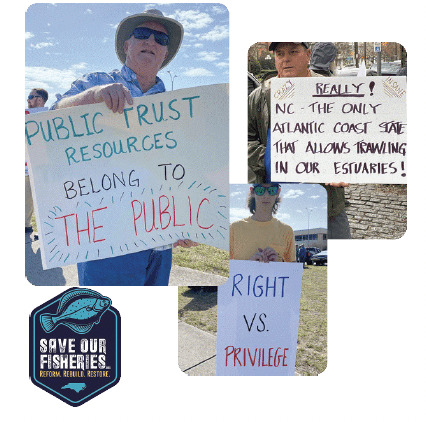


Our coast faces ever increasing challenges every day. Sea level rise is accelerating shoreline erosion, excessive development is putting habitat at risk, water quality is suffering from pollution, sedimentation, and hypoxic events. On top of all that, managers and politicians in North Carolina are allowing, even encouraging, wasteful and destructive fishing practices that put our dwindling marine resources in further danger. So, what can I do, you ask? If you want to help, there are several things you can do every day that will make a big difference.
AT HOME:
You have heard some of this a million times before, but it still should resonate. Don’t litter, recycle as many products as possible in your community, and start a compost pile for your garden. Reconsider the practice of releasing balloons. They are especially dangerous to sea turtles that confuse them for jellyfish, one of their favorite foods, and ingest them. You can donate clean, used Christmas trees to local organizations that are working on shoreline or dune stabilization projects. You can also do a neighborhood clean up (or participate in a clean up sponsored by a local organization, like NC Wildlife).
IN YOUR YARD:
Use pesticides, herbicides, and other chemicals SPARINGLY and only when absolutely necessary. Be responsible when applying fertilizer, taking care to never overfertilize. When these chemicals leech into our creeks, rivers, and sounds, they are acutely toxic to invertebrates like oysters, crabs, and shrimp. Wherever possible, landscape with native trees, shrubs, and turfgrass. They use less water, are adapted to the local climate, and are beneficial to our native critters. These plants will also require less frequent applications of fertilizer and other chemicals.
ON THE WATERFRONT:
If you happen to have waterfront property, consider installing a living shoreline of native marsh grasses. Even a small area planted in front of a sea wall will have beneficial effects. Living shorelines restore natural habitat, attenuate wave action which reduces erosion, serve as protected areas for juvenile organisms, and help concentrate gamefish. If you have a dock, consider placing hard materials, like used oyster shells, underneath that will serve as area for baby oysters (spat) to colonize.
ON THE WATER:
Be sure to correctly stow all gear and trash that you generate. Keep your boat properly maintained. Not only will it be more economical for you, but it will lessen the chances of fuel and oil leaking into our waterways. If you see trash floating in the water (especially plastic bags or balloons), take a moment and pick it up.
When you are out fishing, use the most ethical angling practices that you can. Netting a fish with a rubberized net minimizes loss of the protective slime that keeps them healthy. Use circle hooks whenever possible if you are using natural bait. Doing so greatly reduces the chance of deep hooking and killing a fish that you end up releasing. Consider replacing treble hooks with safer in-line hooks, or pinch down the barbs on any trebles that you use. This greatly reduces the damage to a caught fish and increases its chance of survival. Practice catch-photo-release as often as you can. Don’t continuously upcull fish that you intend to keep. Riding around with a fish in the live well for hours greatly reduces its chances of survival when released. Perhaps most importantly, don’t keep any more fish than those you know you will use. Filling up a cooler with fish simply because you are allowed to is not practicing good conservation. By all means, keep what you need, but let the rest swim away to grow and spawn. That is the only way we can ensure that our populations will remain healthy in the years to come.
GET INVOLVED:
As mentioned throughout this article, you can do quite a few things around your house and in the water to minimize many of the challenges that we are facing on the coast of North Carolina. You can also get involved in the process by researching the issues of most importance to you, attending those meetings, and commenting to our managers and politicians about the solutions that make the most sense. If politicking like that is not your cup of tea, you can always contribute to the organizations that most closely match your views on a given policy. CCA NC has been fighting hard for decades to preserve and protect our coast and its fisheries. We would certainly appreciate your support as we continue that work.