

By Tom Champeau, Pisgah Chapter of Trout Unlimited
Due to concerns about the effects of air pollution on public health, air quality in the U.S. has steadily improved since 1970. Enactment of the Clean Air Act under the Nixon Administration initiated programs to improve the Nation’s air quality. Reductions in smog, ozone-depleting compounds, mercury emissions, and pollutants that cause acid precipitation have occurred in the U.S. and in many other countries; proving that with international cooperation, public demand, development of new technologies, and political responsibility, air pollutants can be reduced from our emissions and air quality can improve. Problem areas still exist in many regions; however, our ability to reduce air pollution is powerful if we possess the public will to make the necessary changes.
Emissions from the combustion of fossil fuels (coal, oil/gasoline, and natural gas) load the atmosphere with sulfur and nitrogen oxides that increase the acidity (lower pH) of rain and snow. Sulfate and nitrate molecules also come down as dry particulates, and with rain and snow, are incorporated into the soil. Acid precipitation decreases the capacity of soil to buffer or neutralize acids before they seep or flow into streams. Reduced soil buffering capacity, soil nitrogen and sulfate saturation, and lower soil pH create complex changes in soil and stream water chemistry. Aluminum and other elements are leached from altered soils that are harmful aquatic life.
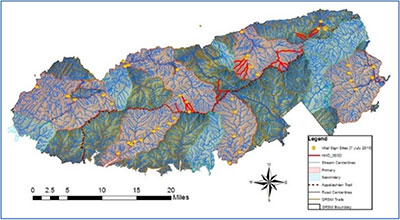
Matt Kulp, Supervisory Fishery Biologist with the Great Smoky Mountains National Park (GRSM) oversees a long-term study of the impacts of acid deposition on stream water quality in the park. Acid deposition has negatively-impacted brook trout and many other aquatic animals in nearly half of GRSM streams. Volunteers, including members of Trout Unlimited chapters from TN and NC, collect water samples from many of the sites analyzed for this study (Figure 1).
Atmospheric sulfates and nitrates along with other air pollutants such as mercury and ammonium travel for long distances, and the geography and elevation of the GRSM traps these pollutants as wind currents move from west to east. The geology of many of the park’s watersheds is low in limestone, and streams within these sensitive watersheds are poorly buffered from acid deposition. Other factors that scientists factor into the impact of acid deposition in GRSM are varying rainfall patterns within the park, forest age/timber harvest history, plant species composition, soil type, and geological composition.
The good news is improved technologies have reduced sulfate and nitrate emissions of power plants and vehicles in areas of the Southeast that contribute to GRSM’s “airshed” and subsequently, air quality within the park has improved dramatically. Since 1993, nitrogen oxides and sulfur dioxide have declined by 72% and 94%, respectively. Over the past 30 years, average rainwater pH in the park rose from 4.3 (very acidic) to 5.3 (normal rainwater is a weak carbonic acid). As pH is measured on a logarithmic scale, the park’s rainfall pH is 10 times better than before 1993.
The bad news is the nitrogen and sulfur loading into the soil changes soil chemistry and it may take decades to show improvement. Stream water quality is more dependent on soil chemistry than air quality. Over time, scientists predict that with improved air quality further reducing acid deposition, soils will lose excess nitrogen and sulfur and retain more calcium that will increase soil buffering capacity. The buffering ability of park streams is measured by the Acid Neutralizing Capacity (ANC) – the degree that positively-charged atoms neutralize negatively-charged atoms that acid deposition loads into watersheds.
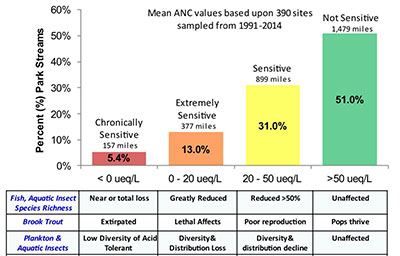
Nearly half or 1,434 miles of streams in the park have reduced ANC with significant impacts to aquatic organisms (Figure 2). In these sensitive streams, brook trout suffer poor reproduction, high mortality, and have been eliminated from the most sensitive streams. Streams that are sensitive, extremely sensitive, and chronically sensitive to acidification effects account for 31%, 13%, and 5.4% of park streams, respectively. Some less sensitive (higher ANC) streams drain watersheds that have more limestone and other rocks that leach cations into the soil and stream. Overall, 51% of streams in the park have geochemistry, rainfall patterns, and forest type and age that sufficiently buffer the effects of acid deposition (Figure 2).
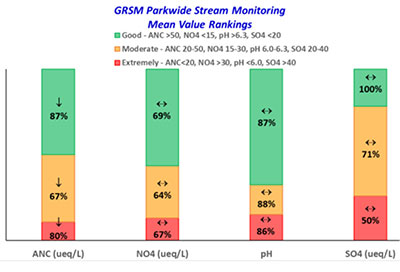
Most stream monitoring sites show fairly stable levels of nitrate and sulfate (Figure 3 – horizontal arrows), which indicates that air quality improvements are not causing further soil loading of nitrogen and sulfur. Stream acidity (pH) is also stable in most streams which is good; however, ANC reductions are still occurring in most streams in the study (Figure 3 – downward arrows). With declining ANC, stream pH may decrease in some streams currently rated as good or moderate. Over the long term, ANC is expected to stabilize and gradually improve as soils lose excess nitrogen and sulfur that accumulated from decades of acid deposition. However, recovery times cannot be predicted. Continued monitoring of streams in GRSM will hopefully show increases in ANC over time and recovery of trout populations in impacted streams.
Significant reductions in harmful gases that cause acid precipitation, ozone depletion, health-impacting smog, and other problems are powerful proof that improving air quality can be achieved through human ingenuity and public will. However, much more must be done to reduce the emission of greenhouse gases, carbon dioxide, methane, and nitrous oxide. Primary sources and percent contribution of greenhouse gases are manufacturing – 30%, electricity – 28%, agriculture – 19%, transportation – 16%, and buildings – 7% (source: Rhodium Group, 2022). Increasing demands for electricity as nations develop, and the expanding use of artificial intelligence will result in significant increases in carbon emissions worldwide. How the warming planet will impact our local climate and cold water habitat required by Southern Appalachian Brook Trout is an area of great concern and current research.