

Grass Flats, March Madness!
With El Niño waning and cold fronts diminishing, water temperatures are rising. Once temperatures reach the lower 70s, the grass flats come alive. As March progresses and temperatures continue to warm, more and more baitfish move onto the grass flats. Snook, redfish, and seatrout follow the bait to feed. It’s truly a magical time of year to fish in Tampa Bay.
Now it’s time to wean yourself off shrimp and start using scaled sardines. Even though you can start catching baitfish on most Bay area grass flats in early March, don’t count on all flats having it. March is a transitional month. There are days when I still have to catch my bait in water 15 to 20 feet deep. That’s why it’s important to always carry a heavy deep-water castnet and a lighter shallow-water castnet. You just never know! Once you’ve loaded your livewell, it’s time to hit the flats.
Snook season reopens this month, and they’re finally starting to move out of the backcountry and the deep-water canals in search of food. Mangrove points and shorelines are excellent spots to catch snook. They like to hang out in these areas to easily ambush baitfish during a good incoming or outgoing tidal flow. 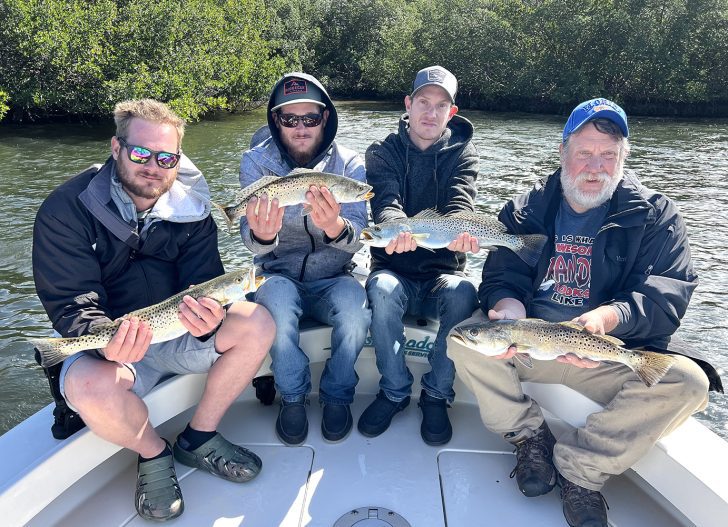
The best way to know if snook are in a feeding mood is to pitch out some live bait. Chumming not only triggers a bite, but it also gives you an idea of how many snook are in your chosen spot. Once snook start popping at some of the bait you just tossed out, cast to the same spot for an instant hookup. The slot limit for snook is between 28 and 33 inches. The bag limit is one fish per person, per day.
Last month, I caught very few redfish over 25 inches; most were less than 18 inches and are commonly called “rat reds.” Rat reds like to hang out around mangrove roots adjacent to deep-water channels and canals.
This month, with warmer water temperatures and higher tide phases, look for slot-size redfish on most grass flats around oyster beds. Also, be on the lookout for mullet. Redfish like to travel the flats with mullet and eat the baitfish and crustaceans the mullet kick up as they feed, while moving across the grass. The slot limit for redfish is between 18 and 27 inches. The bag limit is one fish per person, with a two-fish vessel limit.
The seatrout fishing started out with a bang this year. There have been days when I’ve had to release as many large seatrout as we’ve kept. All have been caught on shrimp in deep water, and it doesn’t seem to matter if the tide is incoming or outgoing. Dead-end residential canals and channels protected from the wind by mangroves have been the hot spots.
Some days, clients catch them on the very first cast; other days, it may take a little while for them to respond to the bait. Once the scent of shrimp spreads throughout the water column and a few are caught, the action really starts to pick up. The slot limit for seatrout is between 15 and 19 inches. The bag limit is three fish per person, with a one-fish over 19-inch vessel limit.
The sheepshead spawn in Tampa Bay is in full swing and runs right through April. Many people associate targeting sheepshead only with bridge and dock pilings. Sheepshead also spawn around rock piles, artificial reefs, and even over sandy potholes on most grass flats.
Sheepshead are referred to as “Convict Fish” and “Bait Stealers.” Some anglers claim that to catch them, you have to set the hook before they eat the bait! I’m not sure about that, but if you get a bite and reel back in half a shrimp, toss it back out. You just might catch that fish on the second go around. The minimum size limit for sheepshead is 12 inches. The daily bag limit is eight fish per person, with a 50-fish vessel limit during March and April.
Afishionado, “Always an Adventure.”