


 By Angler Magazine Staff
Where do I begin?
That’s sometimes a difficult question when you’re talking about fishing in Western North Carolina. I could give you a list of streams, tell you where they are, what lives in them and maybe even what fly to throw.
But where’s the fun in that?
If you’ve spent any time wandering around these mountains with a fly rod in your hand, you already know that some of the best fishing trips begin with a map, a back road and the thought, I wonder what’s up there?
Canton, North Carolina, is a pretty good place to start wondering.
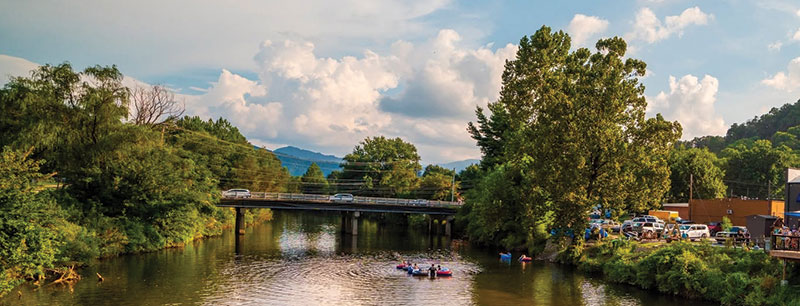
Sitting in Haywood County with the Pigeon River running right through town, Canton is surrounded by some of the most beautiful mountain water in Western North Carolina. You can unpack your bags, make Canton your base camp and spend several days fishing without having to fish the same kind of water twice.
There are larger rivers, little mountain tributaries, stocked trout water, wild trout streams and even a mountain lake just a short drive away.
And then there are those little creeks disappearing into places where the rhododendron seems determined to prevent a fly fisherman from entering.
Those are usually the places I want to go.
Follow the Water
The Pigeon River watershed reaches deep into the mountains surrounding Canton. Follow its forks and tributaries toward their beginnings and the character of the water changes.
The river gets smaller.
The roads get narrower.
Eventually the pavement may disappear altogether.
Cold, clear water tumbles down from the high country, gathering in little branches and creeks before beginning its journey toward the Pigeon. Some of these tributaries hold trout. Others are simply beautiful places that remind you where a mountain river comes from.
The West Fork of the Pigeon River, running through the country around Lake Logan and below Cold Mountain, is one of the better-known trout waters in the area.
But don’t let the named water on a map become the entire adventure.
Look at those little blue lines feeding it.
I have a weakness for little blue lines.
Some lead nowhere. Some lead to waterfalls. Some lead into rhododendron hell where you’ll spend more time untangling your fly from a bush than fishing.
Every once in a while, though, one leads somewhere special.
That’s part of what makes fishing around Canton so much fun. You’re surrounded by water, and there’s always another bend in the road or another creek coming down from the mountains asking to be explored.
Jonathan Creek and Maggie Valley
Drive west from Canton toward Maggie Valley and you’ll encounter another piece of Haywood County’s fishing story: Jonathan Creek.
Jonathan Creek flows right through Maggie Valley, and that’s part of its charm. You don’t have to hike five miles into the backcountry to reach it. There are places where you can park, walk to the water and start fishing.
Sections of Jonathan Creek are managed as public trout water, giving anglers an accessible opportunity to wet a line without having to disappear deep into the backcountry.
It’s an especially good place to introduce someone to mountain trout fishing.
But there’s another part of the Jonathan Creek story that I like.
People care about it.
There’s been a growing effort throughout Haywood County to clean up waterways, protect these mountain streams and recognize just how valuable they are to the communities they flow through.
That matters.
A trout stream running through the middle of a community can become something people drive past without noticing.
Or it can become part of the community.
Jonathan Creek is the latter.
Walk along it. Fish it. Sit beside it for a while.
And if you see a piece of trash along the bank, pick it up.
Maybe pick up one more.
A Change of Pace at Lake Junaluska
Keep exploring and you won’t have to travel far before the moving water gives way to something completely different.
Lake Junaluska offers an angler a chance to slow things down.
If you’ve spent the previous couple of days crawling over rocks, ducking under rhododendron and trying to put a dry fly into a hole about the size of your kitchen sink, that might not be such a bad thing.
The lake offers fishing for bass, crappie, bluegill, perch and trout, among other species. Fishing is open to the public in designated areas with a valid North Carolina fishing license.
Put down the little three-weight for a while and pick up something with a little more backbone.
Or don’t.
I’ve never been very good at telling somebody what kind of fishing they’re supposed to enjoy.
That’s one of the things I like about Lake Junaluska. Fishing doesn’t necessarily have to be the entire reason for going there.
Bring the family. Walk around the lake. Rent a kayak or canoe. Watch the birds and waterfowl. Find somewhere to sit and enjoy the mountains reflected across the water.
And, naturally, bring a fishing rod.
There’s something else about Lake Junaluska worth mentioning.
People are taking care of this water, too.
The lake has promoted clean-fishing efforts encouraging anglers to think about discarded fishing line, tackle and the effect we can have on the wildlife that shares these waters with us.
I like that.
As fishermen, we’re usually pretty good at noticing what comes out of the water.
Maybe we should pay just as much attention to what we leave behind.
Take your fishing line with you. Pick up that empty bottle beside the bank. And if somebody else left something behind, maybe grab that too.
Leave the place a little better than you found it.
After all, these waters belong to the next fisherman too.
Then There Are the Smokies
Of course, eventually my eyes always turn west.
Great Smoky Mountains National Park isn’t far away, and for a trout fisherman who enjoys exploring, that’s where things can get interesting.
The Smokies contain hundreds of miles of fishable streams ranging from larger, easily accessible water to tiny headwater creeks holding wild Southern Appalachian brook trout.
Some require little more than pulling into a parking area.
Others require a backpack, a map, some good boots and questionable decision-making skills.
Those are usually my favorites.
There’s something different about catching a wild trout in a mountain stream. Maybe it’s knowing that the fish belongs exactly where you found it. Maybe it’s the cold water, the moss-covered rocks or the realization that you’re standing in a place that has looked essentially the same for generations.
Whatever it is, these mountains have plenty of it.
Just remember that Great Smoky Mountains National Park has its own fishing regulations. Know them before you go, carry the appropriate license and treat those wild fish—and their home—with the respect they deserve.
Stop at the Fly Shop
Before heading into the mountains, stop by Mountain Fly Outfitters in downtown Canton.
Local fly shops are important.
Sure, you can buy flies and leaders online. What you can’t order from a website is somebody standing behind the counter saying, “If I were fishing today, I’d probably head over there.”
That kind of information is worth considerably more than the three flies you came in to buy and somehow turned into a $75 purchase.
We’ve all done it.
Mountain Fly Outfitters is more than simply a place to pick up a few flies or replace the leader you managed to leave sitting on the kitchen counter. A good local fly shop is part of the fishing community.
These are the folks who know the water, talk to fishermen coming off the streams and understand what’s happening from one week to the next.
Stop in. Buy something. Ask questions.
Just don’t expect them to give away all their secret spots.
I wouldn’t trust them if they did.
Stay Awhile
Here’s the point of all this.
Canton is a wonderful place to stay if fishing is part of your reason for visiting Western North Carolina.
Make it your base camp.
Fish the Pigeon. Explore the West Fork. Spend a morning on Jonathan Creek in Maggie Valley. Take an afternoon and slow things down at Lake Junaluska. Study a map and investigate one of those little blue lines you’ve been staring at. Then dedicate a day—or three—to wandering around the Smokies.
And when you’re not fishing, there’s plenty more to do.
Drive the Blue Ridge Parkway. Hike to a waterfall. Visit Maggie Valley. Explore Waynesville. Walk around Lake Junaluska. Grab a meal or a beer in town. Take the family sightseeing in Great Smoky Mountains National Park.
Or just sit beside the river for a while.
And here’s the thing about visiting this part of the world.
Every once in a while, somebody comes here for a few days and starts wondering what it might be like if they didn’t have to leave.
I understand that.
If your fishing trip turns into looking at cabins, mountain homes or a little place of your own somewhere near all this water, Thomas and Christine Mallette with Heritage, Better Homes and Gardens Real Estate can help you figure out what comes next.
They’re local people who know the area, and they’ll take good care of you.
I spent a good portion of my life traveling around the world before realizing that the place I had been looking for was right here in these mountains. There is adventure everywhere.
Sometimes all you need is a fly rod, a map and a little blue line disappearing into the mountains.
And sometimes you find a place that makes you want to stay.
Canton is a pretty good place to start looking.