
October is one of the best months of the year for catching large redfish in Tampa Bay. Although redfish are year-round residents, the bigger breeder fish become more predictable as the water cools and bait gathers along the mangrove shorelines. After the long heat of summer, the lower water temperatures bring new life to the flats, and the big bruisers begin feeding with more confidence around points, cuts, potholes, and current-swept edges.
After a short run to catch bait at my secret spot, we headed for Weedon Island. Once we reached the no-motor zone, I lowered the trolling motor. Many islands and keys in Tampa Bay are protected areas, and anglers must rely on a trolling motor or push pole. It pays to know the rules, respect the habitat, and move slowly because FWC keeps a close eye on these areas.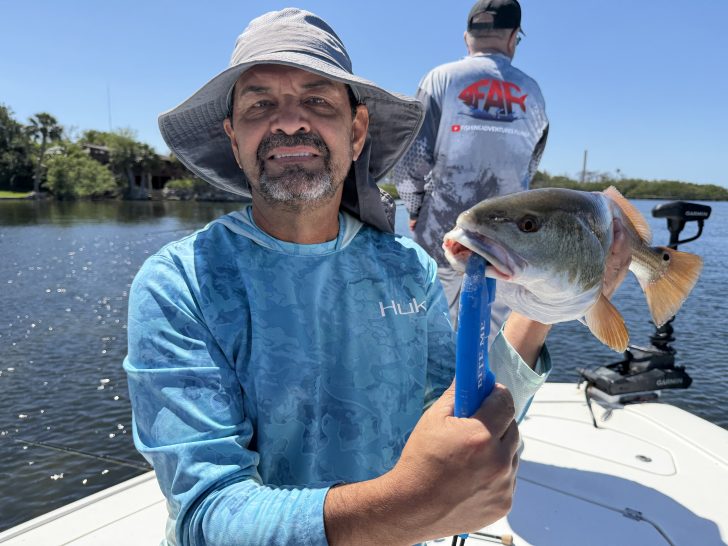
We worked slowly toward the southeast point of the key, watching nervous bait, pushing wakes, and mullet activity. Once we found the right mix of current, grass, and mangrove cover, we anchored and waited for the school to appear. Patience is one of the most important parts of red fishing. A shoreline can look empty one minute and then suddenly come alive when a school slides in with the tide.
We were prepared for action with several bait presentations ready to go. One rod carried a live pinfish suspended just below the surface under a float, another had greenbacks free-lined beyond the float, and a third was rigged with cut pinfish and a small split shot to keep the bait on the bottom. Rolando drew first blood, and within a split second another rod bowed over. For more than three hours, we had the school to ourselves, battling reds, winning some fights and losing others.
Large schools of redfish often congregate around mangrove islands in the fall. My favorite baits for these fish are 3- to 5-inch pinfish, fresh-cut pinfish, greenbacks, and dollar-size pass crabs. Casting distance is a must because these fish are wary in skinny water. Medium tackle works best: I prefer 15-pound braided line, a 7-foot-6-inch medium-action, fast-taper rod, and 3000- to 4000-size spinning reels for long, accurate casts and enough backbone to control a big fish around grass and mangrove roots.
Redfish in shallow water spook easily, so stealth is the key. Keep a safe distance from the school, avoid slamming hatches, speak quietly, and use the trolling motor sparingly. The best approach is to position the boat ahead of the fish, stay still, and let the school come to you.
I prefer to fish the start of the outgoing tide for reds because, as the water drops, bait and fish are pushed into cuts, potholes, and troughs around the mangrove islands. Get there early, stay ahead of the tide change, and be willing to wait. Never cast directly into a school of redfish; instead, cast ahead of them and allow your bait to settle naturally in their path. On days with stronger current, I will use a float and let the flow drift the bait toward the fish.
Capt. Sergio host of Fishing Adventures Florida Show on YouTube, Carbon TV, Waypoint TV, Angling TV and GEN7 Outdoors TV. CEO of Reelfishy.com Fishing Charters. He can be reached at (813) 973-7132 or email atanes@msn.com