

Flounder–The Overlooked Fish
Tampa Bay offers anglers a wide variety of species, including redfish, snook, trout, and cobia. As a charter captain, I find that snook is the most requested inshore species, followed closely by redfish. One often-overlooked fish is Paralichthys lethostigma, commonly known as the Southern Flounder.
Southern Flounder, often called “doormats,” blend easily into sandy or muddy bottoms near grass-bed edges and channels. They typically weigh 2 to 4 pounds, though some reach 8 pounds. Strong fighters on light tackle and prized for their flavor, they are often caught accidentally while anglers drift flats or cuts for redfish and trout.
Although you can catch Southern Flounder year-round, the cooling fall months are prime time for doormats. October through December are my favorite months because, when other fish are slow to strike, flounder remain ready for an easy meal. Because they feed on the bottom, the following techniques can improve your chances of catching larger fish.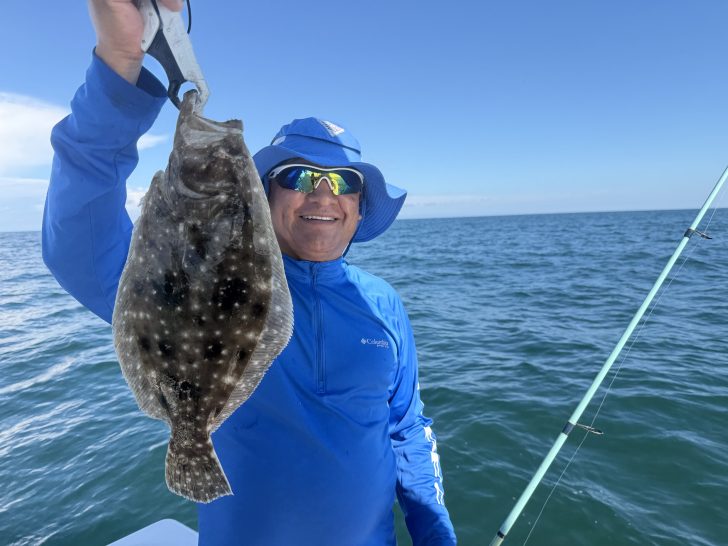
Live Bait Fishing—Drift along the outer edges of grass beds or beside channels with structure or rubble. In 2 to 6 feet of water, use a 1/4-ounce jig head. Hook a sardine (“greenback”) through the nose or a shrimp through the tail. Bounce the jig along the bottom and let the boat’s drift provide the action. In 6 to 10 feet of water, use a 3/8-ounce jig head. Another method is a Texas rig: use a 1/0 hook, a small bead just ahead of the hook, and an egg sinker, starting with ¼ to 3/8-ounce sizes based on depth and current.
Artificial Baits—During cold fronts, use a 3/8-ounce jig head with a 3-inch tail. In recent years, scented artificial baits have helped me catch more fish than live bait. Anchor along the outer edges of grass beds or deep channels and cast up-current or up-tide. Bounce the jig along the bottom with a slow retrieve. Because flounder travel only short distances for food, keep the presentation close and make plenty of casts to improve your odds.
Dock Fishing—Docks are another productive place to catch large flounder. On cold, windy days, warmth around concrete pilings naturally attracts them. Seawalls that drop quickly to a sandy bottom are also excellent spots.
Rocky Bottom—I catch most of my larger flounder along the outer edges of ledges and rock piles in the middle of the bay. I typically use a 3/8 to 1/2-ounce jig head with a 20-pound fluorocarbon leader 3 to 4 feet long. Please ensure your jigs have a 1/0 to 2/0 hook size; I have seen some with 3/0 hooks, which are great for trout but not for flounders.
Tackle—My preferred setup is a 7-foot Ohero Hyper (Lee Fisher Sports) medium-light rod rated for 10 to 17-pound test, paired with a medium-size reel such as the Florida Fishing Products Salos 4000. Because fall often brings windy conditions, I use FINS Windtamer braided line to minimize wind knots. I also prefer braid when targeting large flounder around docks because it performs especially well in that setting.
Locations:
Old Tampa Bay
Double Branch Bay entrance has several oyster beds with sandy shoulders
Big Island cut west end of Howard Frankland Bridge
Culbreath Flats
St. Pete power plant hot water outflow-fish the drop along the mangroves during cold snaps; beware of restrictions since 911.
Lower Tampa Bay
Port Manatee spoil island drop
Joe Island west end
Apollo Beach canals
Terra Ceia Bay
Bird Key
Flounder Pass
Southern Flounder will offer a change of pace and taste, so don’t overlook the doormats of Tampa Bay. Please e-mail any questions concerning fishing or tackle and I will be glad to respond.