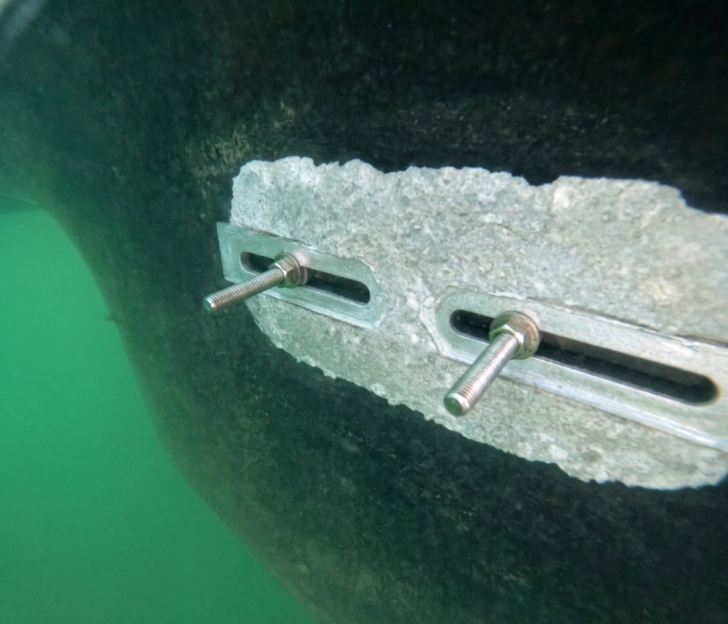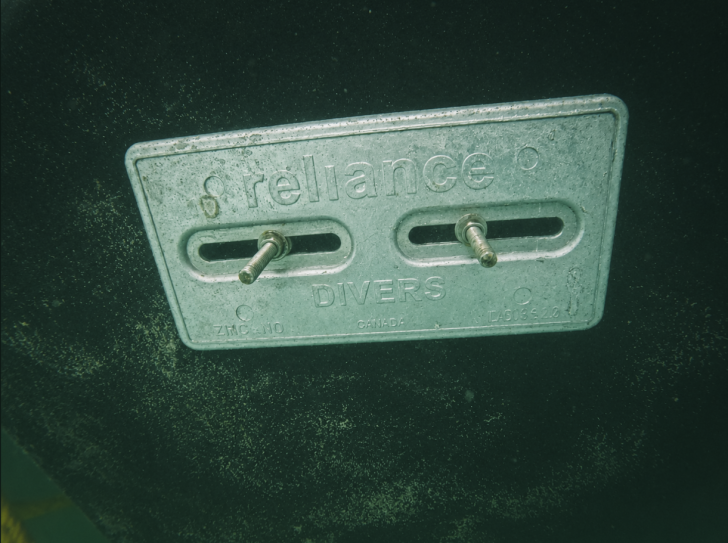

“How fast should my zincs burn?” is the most common corrosion question on the dock, and the
science gives a sharper answer than “every few months.”
Anode life is governed by electrochemistry, not the calendar. In seawater, dissimilar metals form a
galvanic cell, and a sacrificial anode is simply the most active metal in that cell, engineered to
corrode so propellers, shafts, struts, and rudders do not. How fast it goes depends on the load placed
on it: salinity, temperature, the amount and type of metal it protects, the bonding system, and stray
current in the slip. Two boats in the same Tampa Bay marina can run very different anode lives and
both be normal.
The protection threshold is defined, not guessed. The American Boat & Yacht Council’s E-2
cathodic-protection standard requires an anode to drive the protected metal at least 200 millivolts
more negative than its natural resting potential, measured against a silver/silver-chloride reference
cell, the same instrument the corrosion engineers at AMPP, formerly NACE International, use to
place marine metals on the galvanic series. A reference-electrode reading taken in the water confirms
in minutes whether a hull actually sits inside its protected range. A zinc still bolted on is not proof of
protection; the millivolt number is.
Material chemistry decides the rest, and here Tampa Bay’s brackish water is the key variable. Zinc
passivates in low-chloride water: it grows an insulating calcareous film that shifts its potential too
noble to protect, so a “long-lasting” zinc in brackish water is usually a dead one. Aluminum has the
opposite history. Raw aluminum also passivates, self-forming a gamma-alumina oxide film that
stalls it near negative 0.7 volts, until it is alloyed with a trace indium activator that keeps the surface
electrochemically open. That indium-activated aluminum-zinc alloy, evaluated for fleet service at
the U.S. Navy’s Naval Surface Warfare Center in Carderock and built to military spec
MIL-DTL-24779, holds roughly 1,100 amp-hours per pound of capacity against zinc’s 368, and
works across salt, brackish, and fresh water. For most local boats it is the technically correct default.
Magnesium, the most active of the three, is a freshwater-only anode; in salt it over-protects and lifts
paint.
That is why a fast-disappearing anode is data, not a verdict. Accelerated loss flags poor
metal-to-metal contact, a degraded bonding connection, an electrically hot slip, or stray current.
Anodes do almost nothing against that last cause, which is separate and fails faster. The reverse reads just as clearly: an anode that looks new after months is typically not bonded to the metal it should protect.
The replacement point follows the same logic: renew anodes at roughly 50 percent consumed, before
protective potential falls off. A thirty-dollar anode is cheap insurance against thousands in running
gear. Below the waterline, the small parts report first.
Jarrett Maryon is a PADI Open Water Instructor and runs Misting Monsoon Diving in St. Petersburg.
B