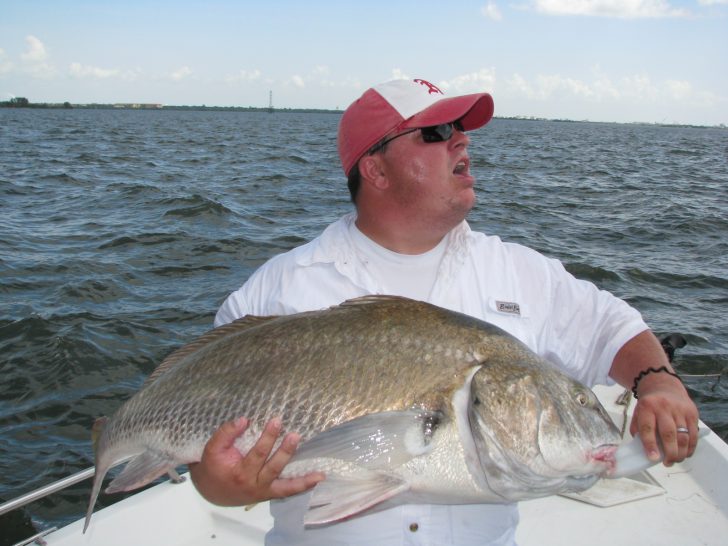

Tampa Bay is famous for its flats and hard-fighting sportfish. While snook and redfish often steal the spotlight, a dark shadow lurks around the Bay’s concrete and stone infrastructure.
Beat the heat and fish in the shade.
The black drum (Pogonias Cromis) is one of the hardest-fighting, most dependable species available to local anglers during the heat of summer. Ranging from four-pound “puppy” drum to sixty-plus-pound “bulls,” these powerful bottom-feeders offer an incredible challenge. If you want to bend a rod on a true Tampa Bay heavyweight, here is how to find and catch them.
Locating the Dark Beast
Black drum are structure-oriented fish. They rely on their sensitive chin barbels and strong sense of smell to detect food. In Tampa Bay, massive bridges like the Gandy, Howard Frankland, Courtney Campbell, and the iconic Sunshine Skyway serve as superhighways for migrating schools. The main shipping channels, deep-water fender systems, and individual concrete pilings attract Drum. Beyond the bridges, black drum frequent the residential canals of St. Petersburg and Tampa, deep shipping ports, and shallow oyster bars. During the winter, low tides push smaller drum into brackish creeks, while spring and summer see massive bulls congregating around deep-water structures.
Rigging for Heavyweights
Because black drum live in the treacherous structure imaginable, light tackle will only lead to heartbreak. Barnacle-encrusted pilings will slice through light line instantly.
For large bull drum, use a heavy 7-foot spinning rod with a 5000 to 8000-class reel. Spool up with 40 to 50-pound braided line. Your leader is your lifeline; tie on 3 to 4 feet of 60 to 80-pound fluorocarbon. I also like a conventional setup with 50-pound mono mainline and 4 feet of 80-pound leader when you want the big ones.
Slide a 3 to 5-ounce egg weight—depending on the strength of the Tampa Bay current—directly onto your mainline, followed by an 80 to 100-pound swivel, then your leader, and tie on a stout 5/0 to 7/0 circle hook.
Baits That Produce
Black drum are opportunistic feeders, but their absolute favorite meal is crab. Quarter or halve the crab, remove the legs, and pass the circle hook through one of the leg sockets. For smaller slot-sized drum, live shrimp, fiddler crabs, and fresh cut bait will get the job done.
The Presentation and Bite
The technique is simple: drop your bait directly to the bottom next to a piling. Reel just enough to come tight to the weight, but keep it on the bottom. Black drum usually do not strike aggressively. You will usually feel a subtle thump on the rod tip. Resist the urge to yank the rod. Instead, let the fish commit, as the rod tip bends, lift slowly to let the circle hook automatically set itself in the corner of the mouth. Once hooked, get ready for a grueling, vertical tug-of-war to keep the fish from wrapping you around the concrete.