
 By Tom Champeau, Pisgah Chapter of Trout Unlimited
Since I was a little kid, I was mesmerized about what lived in the water. I suppose I was influenced watching Sea Hunt, Flipper, Voyage to the Bottom of the Sea, and The Undersea World of Jacques Cousteau, and cannot remember when I got my first mask and snorkel. Growing up in Michigan, I braved many chilly lakes to see what was beneath the surface.
I got SCUBA-certified in college while taking a class in underwater research methods as part of my biology major. My career as a fisheries biologist was in Florida, and I used SCUBA to measure aquatic vegetation communities, evaluate fish population abundance and behavior, construct fish attractors, and even inspect the condition of boat ramps. Seeing fish interacting in their environment helped augment the standard fish population data collected with nets and electrofishing gear.
Living in Florida is a dream come true for a snorkel and SCUBA diver. The Florida Keys is the third largest coral reef system in the world. The first time I dived off Key Largo, I was amazed by all the popping and clicking sounds coming from thousands of coral polyps. Summer lobster season is a treasured tradition for many Floridians, and snorkeling the grass flats along the Gulf Coast for scallops is great family fun in hotspots such as Homosassa, Steinhatchee, and St Marks.
Florida hosts the world’s greatest concentration of freshwater springs in the world, including many of the largest and deepest. On a hot summer day, the water is a refreshing 70 degrees as you descend down to the bottom of a spring bowl to a vent that constantly discharges water from the massive Floridan Aquifer. The state’s karst geology created these surface connections to deep limestone layers that formed as ancient seabed’s millions of years ago.
 Some sinkhole formations offer divers a surreal trip into dim caverns, some massive in size. Only with specialized training and equipment should divers enter a cavern where the surface entrance is not visible and flashlights are needed. Entering a cave with only basic SCUBA is an invitation with death and dive clubs post signs at cave entrances picturing the Grim Reaper warning the untrained to venture no further.
Crystal clear spring runs like Ichetucknee, Rainbow, and Weeki Wachee are fascinating to snorkel, just drifting with the current is an amazing experience. While many folks understandably worry about alligators and venomous cottonmouths, we usually had a spotter in a canoe or kayak with us making sure these critters stayed away; and over decades of Florida freshwater diving and snorkeling, I never had a scary encounter. Swimming with manatees in coastal spring runs is incredible, and the Three Sisters Spring in Crystal River is one of two areas (Homosassa River being the other) where you can legally get in close proximity to these gentle herbivores.
While it is fun to reminisce about my diving experiences while living in Florida for 38 years, I sadly have to share that the coral reefs, grass flats, and springs are not what they were in the early 1980’s when I first experienced them. Climate change has warmed waters of the Gulf and Florida Straits causing coral bleaching – when stressed coral expel symbiotic algae living in their tissues, leaving them vulnerable to starvation and disease. The last trip I made in 2017 was so depressing – the coral sounds I found so amazing were gone, just silence as I swam among bland rocks that used to be covered with living coral of many colors. Fish still congregated around the rocks, but they were different species, and less diverse and abundant.
Groundwater pumping to quench the thirst of Florida’s 23 million residents, agriculture, and industries reduced discharge of many springs and hundreds of years of nutrient enrichment of the state’s porous soils increased phosphate and nitrate levels coming out of the springs triggering blooms of filamentous cyanobacteria. Along spring runs, healthy beds of eelgrass have been replaced by noxious algal mats. Out in the bays, this nutrient enrichment (cultural eutrophication) has decimated many grass flats around the state. I don’t mean to depress you, and some folks who didn’t see these resources 40 years ago can still have wonderful, unforgettable experiences. But for me, I know and have seen too much.
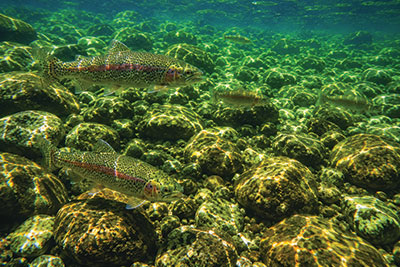
Leaving Florida seven years ago for western North Carolina has provided me an unexpected and wonderful appreciation for experiencing our rivers and streams. My joy of watching the underwater world has been renewed. With a wetsuit (I lived in Florida too long to tolerate cold water), mask and snorkel, I love to spend warm summer days snorkeling when it is too hot to fish for trout anyway.
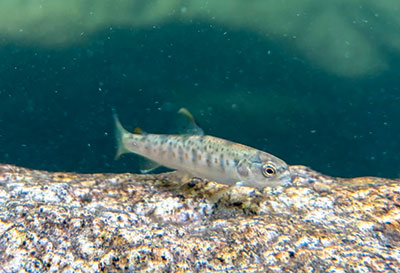
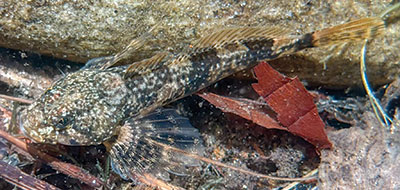
In the Davidson River near Brevard for instance, I typically see over a dozen different species of fish utilizing rocks, ledges, riffles, and runs as their various adaptations allow. Coming across the ancient amphibian, the Hellbender, is a special treat as this is one of the largest salamanders in the world and has existed for millions of years in clear, cool rivers of the eastern U.S. While habitat loss has greatly reduced its current range, state and federal protections along with proper management of forested watersheds will help conserve this species.
 If you are interested in taking upriver snorkeling, I have a few tips. First watch some YouTube or TikTok videos – an internet search for “underwater videos of Appalachian snorkeling” will yield a good list. Produced by Freshwaters Illustrated in 2019, “Hidden Rivers” is an excellent choice. If you are interested but desire help, Oxbow River Snorkeling out of Rosman is a guide service that provides equipment and expert interpretation. Check out the North Carolina Wildlife Resources Commission’s Blue Ridge Snorkel Trail website that provides detailed information on over ten public sites. The Pisgah River Rangers are offering free snorkel programs every Wednesday in July at the Davidson River near Brevard. Instruction and all gear are provided. For information and registration, visit https://linktr.ee/pisgahriverrangers.
As an avid trout angler, I have learned a lot about how trout of various species (rainbow, brown, and native brook) and wild vs hatchery-raised orient in different habitats and flow velocities. It is fascinating to see how they use subtle bottom structure to maintain position within the best feeding lanes. If you move slowly and can stay still, spooked trout will quickly return to where you saw them flee and resume their normal behavior. Sometimes it is not possible to differentiate between wild and hatchery fish, but most times, at least in the Davidson, I can tell by their size, behavior, and habitat preferences.
A few tips to stay safe: Never snorkel alone – dive with a buddy or have an observer on shore watching you all times; keep yourself downstream of downed trees and any woody debris – the depths and currents will surprise you and you don’t want to get washed into a debris pile. Rocks are slippery so I wear an old pair of wading boots. Take frequent breaks to rest and warm up. Moving around in the current and cold water is exhausting and you can become hypothermic very quickly. Finally, if you have any health conditions, talk to your doctor to see if snorkeling in cold water is wise.
So, consider trying out the fun and amazing experience of river snorkeling and fish watching. What you learn will help your fishing success and you will gain a tremendous appreciation for our diverse aquatic ecosystems. The essayist Scott Russell Sanders wrote. “We treat with care what we love, and we love only what we have truly learned to see, with all our senses alert.”