

By Tom Champeau, Pisgah Chapter of Trout Unlimited
All trout anglers know that their favorite quarry requires cold water to survive. Rainbow trout, native to the Pacific Northwest, and brown trout, native to Europe, were stocked in the Eastern United States for the past 120 years to replace native brook trout after their populations were decimated by widespread timber harvest and watershed development. Brook trout are a species of charr that arose in northeast Canada 10 – 15 million years ago. All trout in North Carolina are from the Salmonid family and suffer when water temperatures exceed 68 degrees.
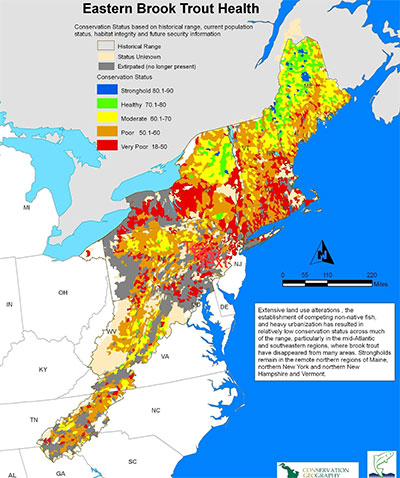
Brook trout expanded to the Upper Midwest and Northeast and were pushed south by glaciers that covered most of northern US and Canada at times by mile-thick sheets of ice. These glaciers advanced and retreated over a period of two million years ending 12,000 years ago. In the Southeast, brook trout continued to exist in the Appalachian Mountains above 3,000 feet, the higher elevation allows groundwater-fed streams to stay cold even as the climate continued to warm. Like spruce, balsam, and fir trees hanging on at higher elevations, brook trout are relics of the Ice Age in the Southern Appalachians.
For a long time, brook trout could freely move between watersheds, migrating downstream to larger rivers where they could find another tributary to inhabit. This allowed streams that had intense fires, floods, landslides, or other catastrophic events that wiped out brook trout to be repopulated. Free movement of brook trout also ensured high genetic diversity that enabled populations to adapt to changing environmental conditions.
As we developed watersheds with farms, cities, roads, dams, culvert pipes, and other barriers to fish migration, brook trout populations became fragmented, putting many isolated populations at risk of local extinction. Low population size and lack of genetic diversity severely limits the ability of brook trout in small mountain streams to adapt and survive in changing conditions. The figure shows where brook trout populations are most threatened.
Two of the biggest drivers of environmental change in Southern Appalachian streams have been acid precipitation and climate change. The April issue of this magazine dealt with long term research findings about the impacts of acid precipitation in the Great Smoky Mountains National Park. Spoiler alert – there is some good news, but you have to look up the April issue to learn the details!
The other big threat that Southern Appalachian brook trout face is a warming climate. The subject energizes great political animus, and some fisheries biologists are hesitant to discuss at talks they give to the public. While future predictions, mitigation measures, and potential economic and social impacts are hotly debated, when it comes to what is happening in our streams, it is good to start the conversation with data collected with thermometers and rain gauges.
The State Climate Office of North Carolina (SCONC) is the primary scientific extension resource for weather and climate science for the state of North Carolina. Located on the campus of NC State University, it was established in 1976 and collaborates with all institutions within the university system. In 2009, NC State created the NC Institute for Climate Studies (NCICS) that is sponsored by the National Oceanic and Atmospheric Administration (NOAA) and is located in Asheville. NCICS analyzes temperature and rainfall data collected throughout the state for over a hundred years and provides reports for the public, agriculture, industry, and local government.
The latest NC Climate Science Report is available from their website: https://ncics.org. Here are some key findings from the report:
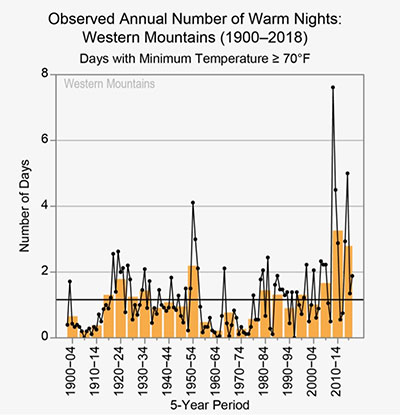
North Carolina has warmed over the past 120 years, and warming has accelerated over recent decades. Nights have been getting hotter and this concerns fisheries biologists, since streams typically release heat at night and if nights are hotter, streams will not cool enough to keep daytime temperatures below 68 degrees.
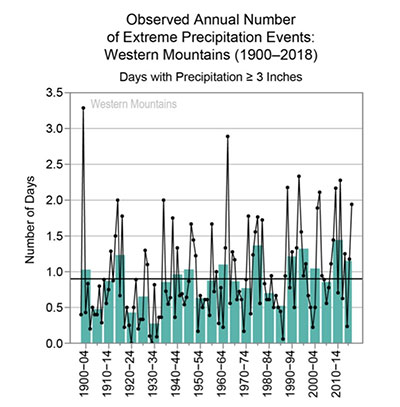
Annual rainfall totals do not show a trend, however, the frequency of high rainfall events (over 3 inches over 24 hours) has increased. Impacts to mountain stream habitat from frequent floods have been documented even before Hurricane Helene devastated many rivers in the Southeast. High flows increase erosion and landslides deposit significant sediment that can decimate miles of benthic habitat.
Brook trout do not fare well under high flows while rainbows do better. Biologists have documented population shifts where rainbows dominate during a series of higher rainfall years, while brookies rebound during drier years. Brown trout do better during lower rainfall periods as well, and this might be related to browns and brookies being fall spawners and higher flow events typically occur more frequently during the late summer/early fall. But when high rainfall events occur during winter, newly-hatched brook and brown trout are extremely vulnerable, and populations can experience year-class failures.
While flooding events are increasing, so are the frequency and duration of droughts. We are in a severe drought now and while hot days, floods, and droughts have always occurred, relying on our memories is not the best approach to understand what is really happening. Weather is defined by annual, seasonal, and even daily extremes in temperature and rainfall. Climate science analyzes changes in long term averages. Distinctions must be recognized between variable weather conditions over the short term, and long-term changes in climate patterns.
Sources: NCICS, NOAA, NCEI, National Centers for
Environmental Information, SCONC
The Earth’s climate is always changing over long time scales – our orbital periods, the sun’s output, shifting continents changing ocean circulation, volcanic eruptions, and asteroid impacts have greatly changed the climate over hundreds of millions of years. For the past 10,000 years that humans have been populating the planet, the climate has been relatively stable. But over the past 150 years since the Industrial Revolution and the burning of fossil fuels for energy production, the rate of climate change has been extremely rapid. Plants and animals have been able to adapt to past changes in climate, but scientists worry that the rapid rate of change that we are experiencing now may exceed their ability of adapt. For trout and many other species in Southern Appalachia, migration is not an option, there is nowhere to go.
To gain a better understanding of mountain stream temperatures, scientists, organizations, and volunteers are installing temperature loggers across the Southeast. Much of this information is being collected and evaluated across the landscape to provide a comprehensive picture of what is happening to brook trout habitat from the Southern Appalachians to Maine.
With these data, biologists can determine which streams are being buffered from summer temperatures by adequate groundwater inflow which keep streams cooler. Also, the amount of tree canopy that shade streams can be evaluated which will inform projects to plant scrubs and trees to reduce solar heating.
 The threats of warming go beyond our native brook trout. Rainbows and brown trout have slightly higher tolerances for water temperatures above 68 degrees but not much. The cellular biochemistry and genetics involved with evolving thermal tolerance to survive at higher temperatures is extremely complex and limits the rate and extent that plants and animals can persist. If more of our trout streams exceed 68 degrees over the summer, we will lose our trout fisheries as they transition to cool and warm water fisheries.
The North Carolina Wildlife Resources Commission measures water temperatures before they stock and decades of data were recently analyzed and published in a scientific paper. The results showed that some stocking sites will have to be eliminated and schedules modified as the water is simply too warm to stock fish. It is bad enough that our native brook trout are threatened by climate change, but when non-native trout stocking is impacted, it should serve as a wakeup call to everyone who loves to fish for trout. So, let’s study the issue so we can move beyond the pathos and understand the science.