


 By Tom Champeau, Pisgah Chapter of Trout Unlimited
Trout in the Classroom (TIC) began with a Trout Unlimited (TU) chapter in Idaho in 1998, and now is administered by hundreds of TU chapters and other organizations in 35 states. Every year over 4,000 schools participate reaching over 100,000 students from kindergarten through high school. TU staff and chapters sponsor about 1,500 TIC schools, and it is a primary element of TU’s youth education program. In North Carolina, eight TU chapters support TIC systems in 73 schools.
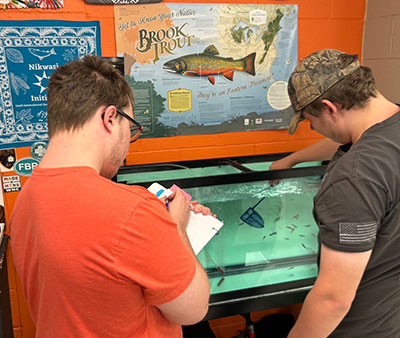
At TU sponsored schools, chapter members raise funds to provide schools with 55-gallon aquariums and all the necessary components to filter water chilled to 50 degrees. Some schools raise their own funds for the program and TU volunteers provide advisory roles. Startup costs are about $1,500 and about $100/school is needed to replenish supplies each year. Grant programs such as the Bass Pro Shops/Cabalas Outdoor Fund have donated to TIC programs across the country.
The goal of the program is to bring live trout into the classroom to provide hands-on educational opportunities in STEM – science, technology, engineering, and mathematics. In addition, most teachers creatively use the program to allow their students to develop skills in teamwork, communication, media and visual arts, music, and creative writing/poetry. TIC and TU websites provide teachers with a wide range of curricula, and many teachers post their applications of the program on YouTube and other social media platforms. TIC curricula also draws connections between what students learn by raising trout themselves to watershed protection, cold water conservation, trout management, and native trout restoration.
 Trout and salmon are provided by state fish hatcheries as eggs, grown by students to juvenile size, and released during the spring in streams and rivers. In coastal areas, shad are raised. The North Carolina Wildlife Resources Commission (NCWRC) provides rainbow trout eggs to TIC schools in September. Rainbow trout are easier to raise than brook trout, but as any TIC teacher can attest, many things can go wrong, and fish die offs are common. Often, classes with good fish survival will donate fish to other schools who lost all their fish so they can complete the program and release fish in the spring. Experiencing declines in fish health and die-offs teach students how sensitive trout are to degraded water quality and highlight the need to protect watersheds and stream water quality.
Students learn the life history of trout starting with counting their fertilized eggs to begin tracking survival and mortality. After a couple of weeks, alevins emerge from the eggs with their potbellies retaining their natal yoke sack. Once the yoke sack is consumed, alevins swim up looking for food. Students carefully measure feed rates to avoid overfeeding which creates harmful ammonia levels in the aquarium. Test kits are provided for students to regularly measure pH, ammonia, nitrite, and nitrate levels. Learning the nitrogen cycle is a valuable lesson in maintaining fish health as well as understanding how this element essential to all life on Earth is cycled in natural systems.
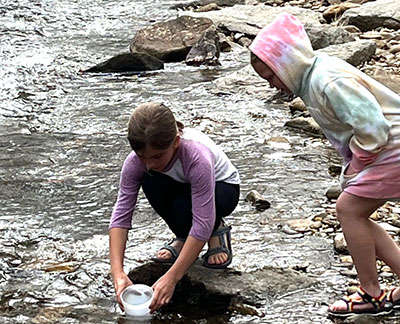
Spring fish releases are times of great excitement for the students as they enjoy a field trip to a local stream. The NCWRC permits releases in Hatchery Supported and Delayed Harvest waters, so students feel they contribute to the future enjoyment of anglers. Following their trout releases, many schools engage students in other activities on the water. Teachers reach out to fish and wildlife agencies, non-profit conservation groups, and other organizations to help sample and identify aquatic insects, teach about forest ecology, and some provide fishing rods to give students a chance to catch a fish.
Witnessing the excitement and joy as students release their fingerling trout and explore the stream is amazing. It is often shocking to learn that many students rarely, if ever, experience trips to a stream, forest, or park. During these release events, many students hold a fishing rod for the first time. Especially, but not exclusively, in urban areas, this disconnect with youth and nature is a very sad but common phenomenon. Hopefully, programs like TIC help expose “nature-deficit” kids to the natural world and spark interest to learn more.
While teachers share how TIC impacts their students with inspiring stories of success, measuring its impacts quantitatively is difficult. In 2024, Clemson doctoral candidate Seth Gibbons conducted research on the impacts of school-based programs including TIC. Seth was exposed to TIC while he was in school and pursued his interest in the program in graduate school to study its impacts on students and educational systems. His dissertation, “Does the participation in research projects that facilitate interactions with local species change feelings of connection” includes extensive surveys of teachers and students and incorporates detailed analyses. From his abstract, some key findings include:
– Greater feelings of connection to the trout the students are raising, greater pro-environmental intentions, increased acknowledgement of responsibility, and awe for the complexity of the aquatic environment.
– Enjoyment of the project and identifying closer with the role of scientists.
– Students feel like they learn alongside other peers.
– Some teachers do not identify TIC strictly as a science-based project.
This study and others like it help provide justification to expand these kinds of hand-on approaches that contrast with traditional classroom teaching. Experiential learning has been shown to improve problem-solving, critical thinking, and personal development, as it helps learners bridge the gap between theory and real-world application.
Tens of thousands of students and parents are impacted by TIC every year, and the credit must go to the dedicated teachers who work extra hard to maintain the aquariums and integrate the program with their curricula. They have an extremely difficult job, and TIC volunteers work to help their students to be successful in raising their fish. While learning the fundamentals of aquaculture, STEM, and many other disciplines, students learn that trout in nature face many challenges. TIC is helping create the next generation that cares about the conservation of watersheds, cold water habitats, and native trout.

Anyone interested volunteering or getting a TIC program started in their school should contact their local TU chapter www.tu.org/chapters/).