

By Thomas Champeau
In the French Broad River, specifically along the “Muskie Mile”, anglers willing to pursue the “fish of 10,00 casts” can experience an incredible experience of catching a monster fish that was historically the apex predator of the French Broad system. While muskie can be found along much of the river south of Asheville, a 3-mile section east of Brevard from Hap Simpson Park Landing to the confluence of the Davidson River supports the best fishery with the last mile considered by many as the “Muskie Mile”.
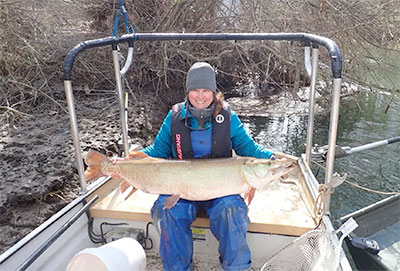
Spin, baitcast, and fly fishing are used to throw big plugs and articulated, bushy flies as close to downed trees and limbs as anglers dare. Muskie lurk in the shadows of submerged wood patiently waiting to ambush their preferred prey of sunfish, suckers, snakes, frogs, and anything else that swims by. They are notorious for following a lure or fly on the retrieve nearly stopping the heart of the angler. Often working the lure or fly close to the boat in a “figure 8” pattern will trigger a reaction strike which results in a wild battle of a 40 – 50 inch fish on a short line. This exhilarating experience makes the challenge of muskie fishing worthwhile.
Muskellunge or muskie (Esox masquinongy) are native to the Tennessee River system, with the French Broad River watershed the southern and eastern extent of its range. From the late 1800’s through the 1920’s, logging, water pollution including major chemical spills, and floodplain alterations from mainly agriculture combined to eliminate muskies from the French Broad by the middle of the 20th century. The Clean Water Act of 1972 and North Carolina pollution discharge regulations during the 1980’s resulted in improved water quality allowing the recovery of the fish community.
The North Carolina Wildlife Resources Commission (NCWRC) began stocking muskies from the Table Rock State Fish Hatchery in the 1970’s and annual/biannual stocking creates a successful put-grow-take fishery. A study published in 1986 documented natural reproduction of muskie in the French Broad, but the lack of habitat suitable for muskie spawning, egg deposition, and fry survival limits the contribution of natural reproduction to the French Broad muskie fishery.
The NCWRC works with the Western North Carolina Muskie Club to distribute hatchery fish in the river to release them in the best habitat and at desirable densities. The club also holds youth fishing derbies and river clean ups. The catch data muskie guides and anglers provide to NCWRC biologists is also essential to evaluate the status of the fishery.
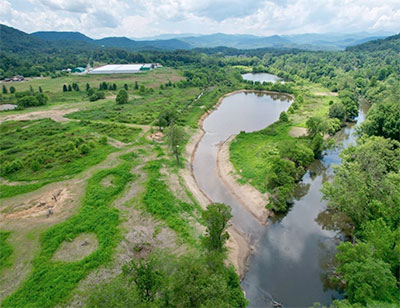
Muskie spawn during spring (mid-March to mid-April) in slow-flowing side channels or sloughs that were typically old oxbows off the main channel. These features were very common along the French Broad corridor historically until humans began developing the floodplain for agriculture. To drain the floodplain and prevent crop inundation, tributaries were channelized, and riparian banks were elevated by berms to keep high flows contained within the river channel. Without the sloughs, muskie reproductive success was reduced and the population gradually declined to eventual extinction.
In 2018, NCWRC biologists began releasing muskies implanted with passive integrated transponder (PIT) tags that can be detected with radio frequency identification devices (RFID) much like the pre-pay toll transponders drivers in big cities often use. By placing RFID detectors along the river, biologists can track movements of individual fish, revealing habitat preferences of muskie during various times of the year.
Working with other agencies, conservation organizations like Conserving Carolina, private landowners, and other partners, projects were developed to restore sloughs and evaluate their effectiveness. Two projects in Henderson County; Mud Creek and Pleasant Grove, created “muskie sloughs” to provide habitat for reproduction, however, they provide habitats for a wide variety of reptiles, amphibians, fish, invertebrates, birds, and mammals.
Conserving Carolina purchased 103 acres of flood-prone farmland in Fletcher where Mud Creek empties into the French Broad. Floodplain restoration was completed in 2020 with three sloughs for muskie spawning. The key to a slough is a direct connection to the French Broad while providing reduced flows and aquatic vegetation. Muskie eggs adhere to the vegetation to develop and hatch. Larval muskie are protected in the vegetation and feed on invertebrates living on the plants. Juvenile muskie feed on crayfish and small fish in the slough until they venture out into the river. When the project was completed, muskies were soon documented in the slough, with some traveling 20 miles to get there. This project also restored acres of wetland habitat that absorbs floodwaters attenuating downstream flows.
The Pleasant Grove property was a failed golf course community south of Etowah that Conserving Carolina purchased and restored in 2023. This 70-acre area now includes creeks, riverside forest, backwater slough, ponds, wetlands, and pollinator meadows. Flood waters from Hurricane Helene covered much of the site, some areas under 15 feet of water. Once the waters receded, project managers were amazed that restored habitats were in good condition, a testament to excellent project design, and luckily, enough time to allow vegetation to establish at restored areas. A RFID recorder installed at the site by the NCWRC (at an elevation of 17 feet above ground – just above the unprecedented flood stage), detected muskies and other fish with implanted PIT tags that swam into the slough as a refuge from the flood. As of January 2026, a total of 44 different muskies have been detected in the slough.
Funding and assistance for the Mud Creek Floodplain Restoration Project came from the U. S. Fish and Wildlife Service, NCWRC, National Fish and Wildlife Foundation, NC Clean Water Management Trust Fund, NC Department of Environmental and Natural Resources, and NC Natural Resources Conservation Service. Funding for the Pleasant Grove project came from the NC Land and Water Fund, NC Department of Public Safety, and National Fish and Wildlife Foundation. Conserving Carolina led both projects that were designed by Greg Jennings with Jennings Environmental. Volunteers from Trout Unlimited, the muskie club, and other conservation groups helped plant native vegetation following slough construction.
Projects like Pleasant Grove and Mud Creek store hundreds of acre-feet of floodwaters that would otherwise add to the torrent that roars downstream during flood events. Following the devastation from Helene, land managers are looking at potential sites along rivers that could be restored. Reconnecting rivers to their historic floodplains, restoring sloughs and wetlands provides flood protection and benefits wildlife. Many communities most impacted by Helene flooding and are struggling to recover have lower incomes than average. Protecting these communities from future floods is essential, and the additional benefits of higher conservation and recreational values will boost economic development that these communities need. This is the definition of restoring habitat to create resilient communities – wildlife and human.