

What do trout anglers need to know?
 By Tom Champeau, Pisgah Chapter of Trout Unlimited
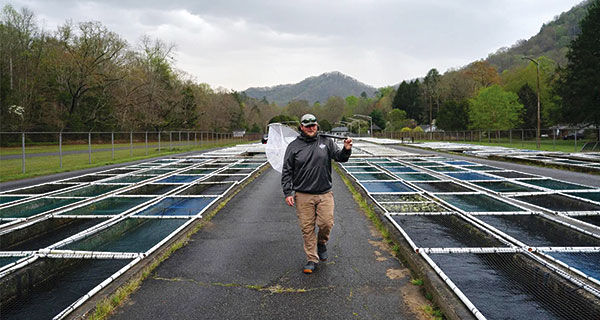
The North Carolina Wildlife Resources Commission (NCWRC) has operated the Bobby N. Setzer Fish Hatchery located in the Pisgah National Forest outside Brevard since 1983 when they took over from the U.S. Fish and Wildlife Service (USFWS). The facility was built in the 1950’s and was already in need to renovation before being damaged by Tropical Storm Fred in 2021. Funding was secured by NCWRC in 2023 for a total renovation of the facility and plans were underway to begin the project last year. However, Hurricane Helene damaged the Armstrong Fish Hatchery near Marion, and NCRWC deferred renovating Setzer until Armstrong was repaired and brought back into operation.
Renovating Setzer is badly-needed; crumbling concrete raceways and water pipes compromised production and the obsolete design precludes the use of state-of-the-art technology to raise fish more efficiently. Advanced water treatment and recycling, and shaded raceways will reduce nutrient and organic waste loading and elevated water temperatures of discharge water. A modern facility will significantly reduce the downstream impacts to the Davidson River from discharge water.
The plan is to demolish most of the existing infrastructure and build a completely new facility. The renovation is expected to take two years at a cost of nearly $40 million with $20 million from the NC Wildlife Endowment Fund and $20 million from funds approved by the General Assembly in 2023. After completion, production will begin and will take another year before the facility will have stock-size fish available for release. If all goes well (managing construction delays, timely procurement of aquaculture equipment, working out bugs of the new system, etc.) the facility will be able to release fish in 2029. But may be 2030 until the hatchery is back to normal production.
The Setzer Fish Hatchery is the state’s largest and produces about 60% of all trout stocked in NC waters. An aging facility that is vulnerable to further damage from future storm events puts the state’s trout put-and-take fishery in serious peril. According to the NCWRC, trout fishing in the state’s 26 counties that support trout generates about $1.3 billion each year. Relying on a hatchery that is held together with duct tape and bailing wire is a bad idea. Replacing this facility will ensure that the state’s trout fishing industry is sustainable and will reduce the downstream impacts of hatchery discharges on a highly-popular catch-and-release section of the Davidson River.
During construction, NCWRC will rely on the Armstrong and Marion hatcheries as well as a private hatchery recently purchased near Rosman. NCWRC is also working with the USFWS, other states, and private hatcheries to obtain additional fish to include in their stocking schedule. The NCWRC website updates information about the project and recently released the projected stocking schedule for 2026 (www.ncwildlife.gov/fishing/trout-fishing-north-carolina). Their goal is to stock all Delayed Harvest and Hatchery Supported locations under the Public Mountain Trout Water program. That said, fisheries managers will be working with a significant reduction in the number of trout available to stock.
So, what does this mean to anglers who enjoy fishing Delayed Harvest and Hatchery Supported streams? This is a large segment of the angling public. According to NCWRC, 1,500 miles of the state’s 8,000 miles of trout waters (19%) receive hatchery fish, and about 80% of the state’s trout anglers prefer fishing stocked streams. Their favorite streams should still receive fish, albeit lower numbers and sizes. The plan that NCWRC is developing to offset the reduction in fish availability will hopefully satisfy the large segment of trout anglers who like to fish for stockers. If your finances allow, many fly fishing outfitters offer guided and unguided fishing on sections of streams that they own or lease that contain fish purchased from private hatcheries. The demand for this service will be high so check around if you are interested in this option.
Over 80% of NC trout streams are Wild-designated supported by naturally-reproducing populations, and while many are not as easy to access as most stocked waters, those on public lands are great places to fish and are close to well-known hiking trails. Many trout anglers, biologists, and forest managers are concerned about the potential impacts of significant increases in anglers fishing Wild and headwater “blue line” streams. Higher fishing pressure on these small streams increases the potential for overharvest, high catch-and-release hooking mortality, and fish stress from being caught during summer. A large increase in foot traffic along stream banks could tramp down vegetation that provide habitat for adult stages of aquatic insects and stabilize bank soils preventing erosion and sedimentation.
Providing information like “Leave No Trace”, “Keep Fish/Em Wet”, and other practices to reduce our impact in these smaller, sensitive streams is important. Please share these important reminders as we talk to anglers, especially our out-of-state visitors who may not be exposed to messaging in our local areas.
-Make sure you clean and sanitize your boots, waders, and landing net to remove potential aquatic invasive species that you may have picked up in other locations.
-Be careful as you enter, exit, and transverse streams to avoid damaging vegetation.
-Use barbless hooks.
-Blueline trout are small, don’t net them – just bring them in, briefly handle with wet hands, and release immediately.
-Resist the urge to photograph your catch. Less handling reduces stress and mortality.
-Bring a thermometer and don’t fish when the water temperature is over 68 degrees.
-Small streams have slippery rocks that will cause you to fall – use a wading staff even in tiny, shallow streams. Three points of contact will keep you upright.
Also, for your safety, many Wild Waters and blue lines are in remote areas with no cell coverage. Fish with a buddy and tell someone where you are going and when you expect to return to cell coverage. The newer phones have the capability to transmit texts via satellite but need an open sky. A tree canopy within a deeply-cut valley may not allow your cell phone to connect with a satellite. A GPS signaling device like a Garmin may send a stronger signal but can also be less reliable in deep valley streams. Carry a whistle that produces a loud, shrill sound. Mountain streams are loud, and you will not be heard shouting for help if you are injured.
Be careful for yourself and the environment around you. Practice catch-and-release and treat your catch with care. When you are fishing a stocked stream, enjoy the day and try to put less emphasis on how many or how big the trout you catch.