
By Cristopher Blanco
Ever since I started fishing, I’ve been drawn to inshore waters. There’s something about tailing redfish on a low tide, backs and copper tails breaking the surface as they root through shallow grass, that keeps me coming back. Add the sudden explosion of a snook under mangroves or the sight of tarpon rolling in the distance, staging in areas that don’t see much pressure, and you have a fishery that constantly fuels my obsession.
For me, the real thrill isn’t just catching fish. It’s finding them. It’s exploring new water, studying tides, reading wind direction, and locating those overlooked stretches where fish feel comfortable. Kayaks have become my favorite way to do exactly that.
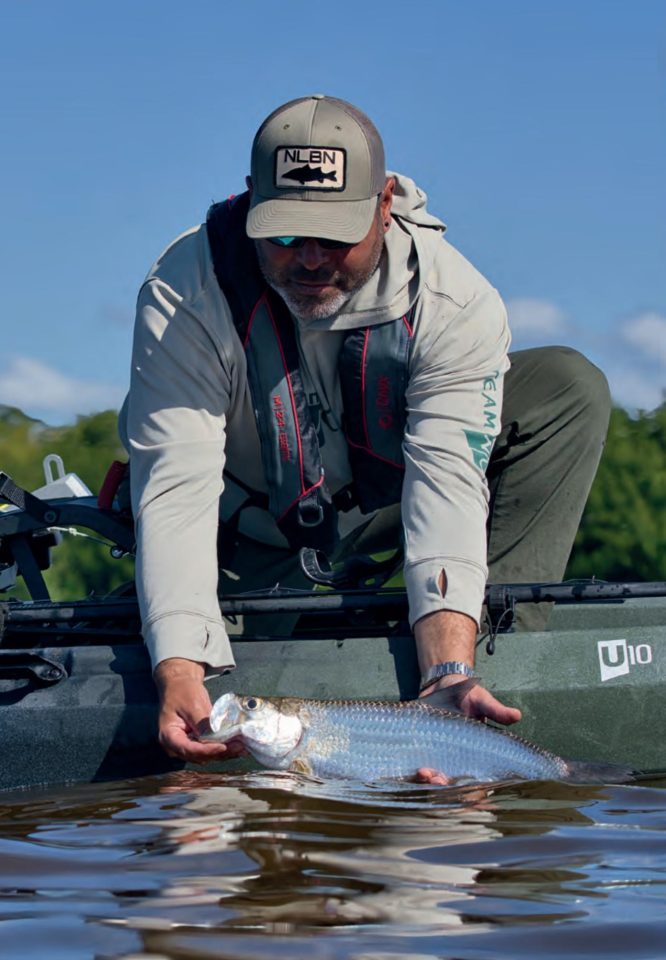
For waters like this, my kayak of choice is the NuCanoe Unlimited 10. At 10 feet, it’s compact enough to maneuver through tight creeks and shallow backwaters, and light enough to launch almost anywhere. Yet despite its smaller footprint, it offers tremendous stability. That stability allows me to stand, sight-cast, and make precise presentations confidently.
Access to the Unpressured
One of the greatest advantages of fishing inshore waters with a kayak is access. Many shallow backwaters, protected zones, and non-motorized areas are naturally quieter. Less traffic means less disturbance, and often, more natural fish behavior. When fish aren’t constantly pressured by noise and prop wash, they act differently. Redfish tail more freely. Snook hold tighter to the structure without being skittish. Tarpon stage in calmer pockets. A kayak allows you to slip into these environments quietly and efficiently, often reaching places others simply pass by.
Navigating the Skinny Water
Inshore fisheries are full of tight spaces: mangrove tunnels, shallow creeks, winding backwaters, and oyster-lined shorelines. These areas demand maneuverability and stealth. With a kayak, you can glide through inches of water, pivot quickly in narrow cuts, and position yourself precisely along structure. You’re not limited by draft or concerned about damaging equipment in shallow zones. Instead, you’re free to follow bait movement, explore hidden coves, and investigate areas that might otherwise go untouched. That freedom opens doors to some unforgettable days.
The Power of Slowing Down
Kayak fishing naturally forces you to slow down. And in my experience, slowing down is one of the most powerful tools an angler can have. I often step out of my kayak when conditions allow. I’ll anchor near a sandbar, walk the flat, and take a moment to observe. It’s not just about casting. It’s about watching bait flicker along the shoreline, noticing subtle current changes around structure, seeing how wind direction pushes surface movement. When you pause and absorb your surroundings, you start connecting patterns. You notice where mullet are nervous. You see shrimp skipping across the surface. You feel how the bottom transitions from sand to grass. Those details matter. And sometimes the best lessons happen when you’re not actively fishing.
A Closer Connection to Nature
Kayak fishing places you at water level. You hear every splash, every subtle swirl. You feel the tide shift beneath you. Birds working bait become immediate clues, not distant observations. There’s an intimacy to it. You’re not just traveling across the water, you’re part of it. That connection builds confidence and understanding over time. It pushes you to learn more about seasonal movements, feeding windows, and habitat preferences. You begin to see inshore water not just as a fishable space, but as a living system.
The Adventure of Exploration
Inshore kayak fishing feeds the desire to explore. Every new creek bend could hold staging tarpon. Every isolated mangrove pocket could hide a trophy snook. Every grass flat could light up with redfish pushing bait against the shoreline. The challenge of finding these overlooked areas, and figuring out how to approach them, keeps things fresh. It’s a constant mental exercise of problem-solving and adaptation. For me, that sense of discovery is what makes the journey worthwhile. The kayak isn’t just transportation. It’s a tool that allows me to reach deeper into the fishery, to move quietly, to observe more, and to learn continuously.
Inshore waters reward patience, awareness, and curiosity. A kayak amplifies all three. And sometimes, the greatest advantage isn’t just access to fish, it’s access to understanding the water in a way that changes you as an angler.