
By Tim Barefoot
Christmas week, in my opinion, is the peak of bottom fishing season, and there are plenty of reasons why. One of the biggest factors is the congregation of bait schools, like cigar minnows and sardines, which are some of the best baits available. Other reasons include the spawning aggregations and the cooler water temperatures. Speaking of bait, grouper (and American red snapper) can’t resist a few others if presented right: pinfish, sailor’s choice, and even small beeliners and other little snappers. These baits are so tempting because larger fish like grouper and snapper see them as egg-eaters. They devour them not only as a food source but also to protect their future offspring from these egg thieves. If you present these baits correctly, and avoid using bulky tackle, they’re simply too enticing to resist.
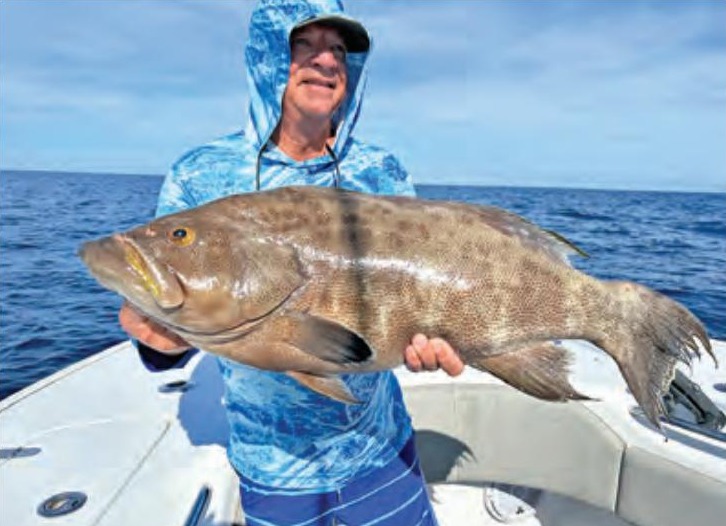
Let’s talk tackle. Forget monofilament altogether! I’ve spent a lot of time observing my tackle underwater, and mono is much more visible than fluorocarbon. Compared to mono, floro is nearly invisible, which makes a difference. Next, think carefully about the weight and terminal tackle you use to get bait to the bottom. While three-way rigs were a classic for years and will still catch younger (female) grouper, it’s a different story when they grow up. Once female grouper mature, they undergo a transformation and become males. When these gag grouper turn male, they also reach a size where we call them “black bellies.” These male grouper, especially black bellies, are intelligent. Not all grouper species are equal in terms of smarts: red grouper are pretty naive, scamps are sharper, and gags are the brightest. They don’t become males, or black bellies, by being careless. Like other animals, fish learn to avoid obvious traps. They recognize mono, three-way swivels, heavy bank sinkers clanking on the bottom, and so on. It’s time to step up your game and target their instincts.
Personally, I use my weight as a “decoy,” making it resemble a crab or squid. This setup involves a 4-foot piece of floro, a small 130-pound Spro swivel, and 50-pound braided line. I also color the first 5 or 6 feet of high-vis (yellow) braid red with a Sharpie. (See my video on YouTube for a demo.) All these details matter for the overall presentation. The “Decoy Jig” is like psychological warfare; it taps into the fish’s hardwired drive to attack struggling or injured prey. The Crab Decoy Jig, for example, looks like a crab holding on to a struggling snapper. To a wary grouper or big snapper, that’s an irresistible “Happy Meal.” I came up with the Crab Decoy Jig after gutting thousands of grouper and realizing that their diet mostly consists of small red and reddish-brown crabs, tiny snappers, cigar minnows and sardines.
The gag grouper and American red snapper populations are stronger than they’ve been in years, just ask any diver! But to catch them consistently, you need to improve your presentation. If you’re not catching gags and scamps with your old “chicken rig,” it doesn’t mean there aren’t any grouper around. They’re just not falling for poorly presented bait.
For a closer look at my setup, visit my YouTube channel.
MERRY CHRISTMAS!
See more from Tim Barefoot at barefootcatsandtackle.com and on YouTube @timbarefoot5698.