
By Capt. Tyler Woolcott, Florida Big Fish Adventures
When it comes to spooling up your reels, the options are endless. For some this can be a bit overwhelming. Hopefully in this article I can help you understand what different kinds of lines are used for and what line strength is the best choice for you.
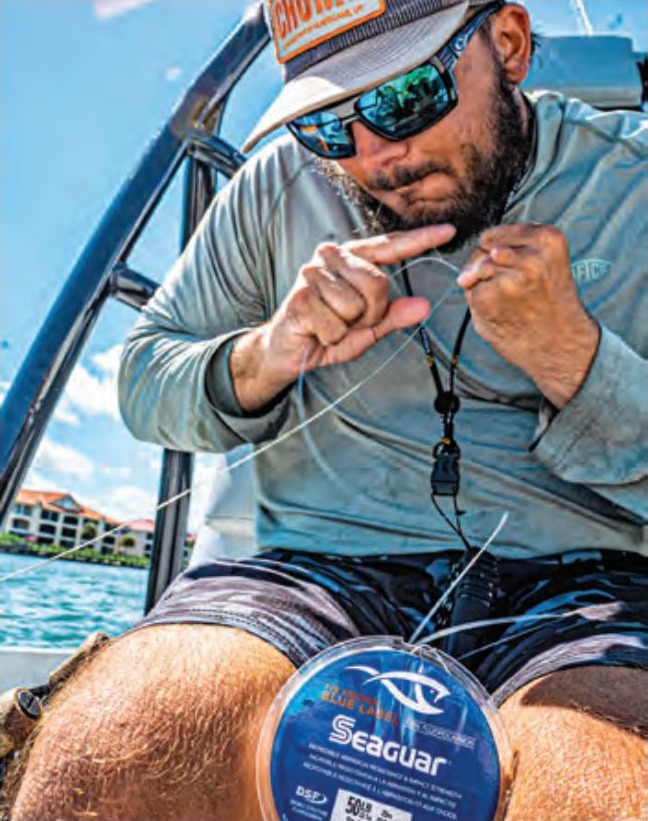
The three main types of lines are monofilament, fluorocarbon and braided lines. Each has its pros and cons in different situations. Monofilament line floats, fluorocarbon sinks and most braided lines also float.
I rarely use monofilament for bass fishing, but it does have its perks for a scenario or two. When throwing big heavy glide baits, I often spool my reels with a very strong 25- to 30-lb. monofilament, as it is very strong and much less prone to breaking on the cast when I am casting a large bait. I also often use mono for a short leader when throwing a topwater bait with treble hooks. I attach about a foot of mono leader to the end of my braid, and it is less visible while also floating to keep a topwater working naturally.
Something to note about monofilament is it’s very stretchy, making it hard to drive the hook of many different lures into the mouth of a fish, especially if you’re using straight mono and have a lot of line out. The more mono you have out equals more stretch.
I use a lot of fluorocarbon in my arsenal of bass-fishing set ups. This line has virtually no stretch, it is more abrasion resistant than most other lines, and it is also a clearer line than anything else, making it harder for fish to see. Unless I am fishing around extremely heavy cover, where braided line is needed to pull the fish out, pretty much every reel I use has fluorocarbon on it. I use anywhere from 10- to 20-lb. fluoro, depending on water clarity, types of cover, and the type of lure I am fishing.
Braid also serves me well in many different applications. Having virtually no stretch, being very strong and extremely thin compared to other lines of the same strength, and outcasting every other line made are just a few perks of braid. The downside of braid is it’s basically tiny thin rope, meaning if you are around clear water fish can probably see it attached to your lure. In some cases, you will need a leader attached to the end of your braid.
Every single spinning reel I own is spooled with braid, which helps them cast better and operate much smoother than if they were spooled with the other kinds of lines. Typically, I’ll use 10-lb. braid and attach a few feet of a fluorocarbon leader in a size of my choice to the end to keep it stealthy. I have 30- to 50-lb. braid on all my topwater treble hook baitcaster rods to make extremely long casts. When fishing around heavy grass and vegetation, I also use braid, typically in 50- to 65-lb. test. This strong line allows you to get the fish out of the mess and into the boat. With your lure being in the grass, you can get away with using a thick braid, as the fish won’t see your line around the vegetation.
Hopefully this helps you understand the different lines better and helps you put a few more fish in the boat.
Tyler Woolcott is a professional tournament angler and guide.