

 By: Capt. Joel Brandenburg
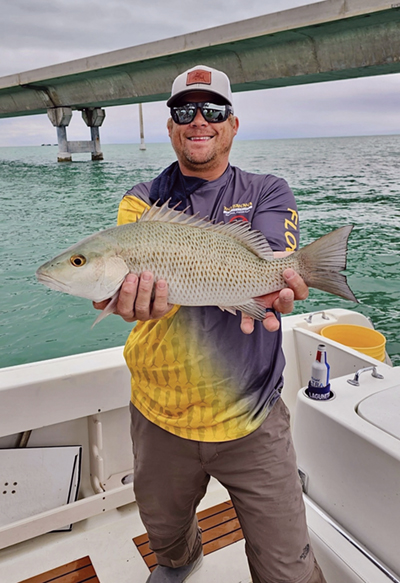
We target mangrove snapper year-round in Marathon Florida Keys as they are a blast to catch on light tackle spinning gear. Many people will tell you after they eating a mangrove snapper that it’s the best tasting fish they’ve ever had! Gorgeous, white, flaky, firm, meat, not very fishy tasting, mangrove snapper tastes excellent no matter how you cook it. FWC offers generous bag limits with an open season for mangrove snapper. Because we frequently fish for them, we understand their pre-spawn, spawn and post-spawn feeding patterns, therefore, we are always trying to increase our quality and quantity mangrove snapper catches. Over the years we have learned where the big schools dwell and how to bag quality sized mangrove snapper. Here are a few of my tips how to target large quantity of mangrove snapper and good quality mangrove snapper.
* Use a bait big enough for big mangrove snapper to eat, make sure your bait is too big for small and medium sized mangrove snapper to fit in their mouth. For example, a chunk of ballyhoo as big or bigger than your thumb is too big for a small or medium size mangrove snapper to fit in their mouth, but just the right size for a large mangrove snapper to suck in. If you are fishing with a chunk of ballyhoo on a jig head many times you’ll feel a peck, peck, peck and following a few pecks you’ll feel a boom. Set your hook on the booms, not the pecks, because the pecks are smaller snapper trying to fit the bait in their mouth, but they can’t. The boom is when the big snapper moves in and pushes the little ones out of the way and sucks the bait in and runs off with it.
* Big snapper love structure. All snapper love structure, but the big ones make a home out of the structure where the smaller snapper come and go. For example, after hurricane Irma in 2017, many big trees were blown off of our islands and onto the flats. They would land in 3 or 4 foot of water and the tree’s giant root balls would anchor their selves in the grass flats. Over time, heavy currents from full and new moon tides made 8 to 10-foot divots under the root balls. We used to catch giant mangrove snapper under those root balls. Eventually, the wood rotted away and over time petrified remnants of the wood would still remain on the bottom with a big white sand divot on the flats that hold big mangrove snapper. We catch the big ones off of wrecks, patch reefs and jagged ledges. Some docks and marinas also hold giant mangrove snapper.
* More is less when it comes to snapper fishing. Even though snapper are very plentiful and hungry fish, they are still smart, and the biggest ones got big because they are hard to outsmart. You can easily outsmart them by using smaller hooks than you would think that you would want. Lighter monofilament, fluorocarbon leader than you would think that you would need smaller weights or jig heads then you might think you would need. Most of the time, we catch the big ones on 10 or 12 pound test monofilament fluorocarbon leader. I used to think when the line companies came out with fluorocarbon and claimed it was more invisible to the fish than regular monofilament line that it was a hoax to increase revenues after getting slaughtered in the marketplace by braided line companies. However, after years of research and development, I don’t think fluorocarbon is a hoax at all. I’m convinced it’s definitely scientifically engineered to be more invisible to fish. Other than smaller line, we love to use 1/16-ounce jig, heads, or in some cases where there is a slack or slow tide we like to use 1/0 short shank, “J” Hook. My personal favorite hook even though I don’t believe it’s made in the USA is Mustad.
* Use a lot of chum. Once you get the big mangrove snapper in a feeding frenzy from chumming they are a lot easier fooled into eating your hooked bait. It’s almost like they get drunk on chum. We like to use a floating chum ring net off the back of the boat. Our favorite chum is sold at several bake shops in town called green tournament chum. Green tournament chum is made in Virginia and for some reason, our Florida Keys snapper breakdance over Virginia made chum, I can’t figure that one out.
The bigger snapper seem to be caught outside the chum line or far back in the chum line. The smaller ones feed in and around the chum bag close. If you are fishing in the Florida Keys or anywhere in South Florida you won’t regret targeting mangrove snapper.