
By Capt. Michael Savedow, Edgewater River Guide
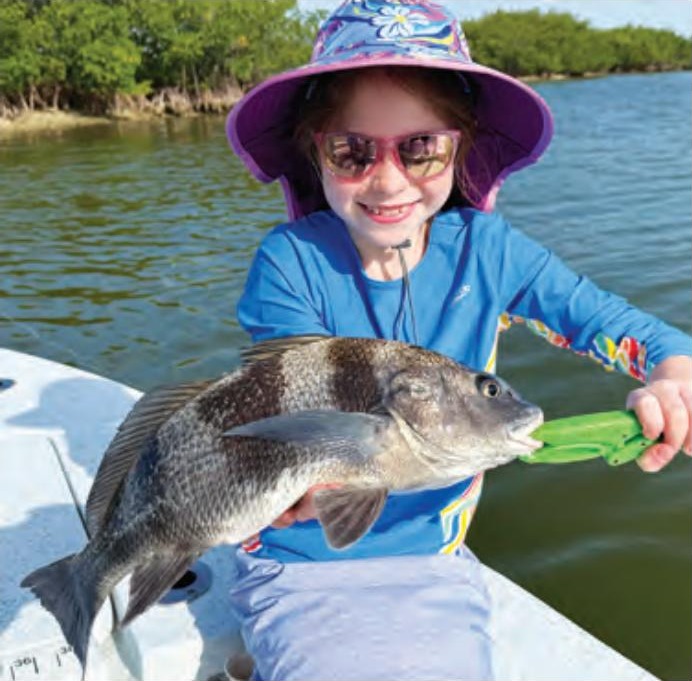
Summer is here, June means school vacation time for the kids, the Indian and Halifax Rivers are great places to teach them the basics of fishing at their skill level, make it easy for them to catch a bunch of fish. For younger children, the best way for them to learn new fishing skills is to fish for the small, abundant panfish such as mangrove snapper and sailor’s choice (aka pinfish). They’ll learn basic techniques they can use in years to come to catch bigger and better fish.
A small hook will catch loads of smaller fish, but it can also hook surprisingly large fish when a big one bites. So use a #4 or #6 hook, a light weight, and a small piece of peeled shrimp. Fish in the right spot and the kids will catch fish one after another. They will learn to bait a hook, fight their fish, then safely unhook them. Snap a quick photo of a few and learn about catch and release. This is the best way for them to learn good fishing skills and they will be better anglers as they grow older.
For kids with a little more experience, teach them to freeline fish with live shrimp, or easy-to-use artificials like a leadhead jig with soft plastic tail. They’ll catch seatrout, ladyfish, jack crevalle, and more. Don’t make it complicated: keep it easy and fun. Teach them about conserving our marine resources, and to be good stewards of our wildlife for the future.
Snook season is closed June, July and August, so catch, photo, and release on linesiders until season opens again on September 1. Our area’s snook population is the best it has been in many years, use gentle care with releasing to keep the good numbers going for years to come. Summer fishing with live pigfish and croakers is a summer tradition on Mosquito Lagoon for seatrout, redfish and snook. These baits are also good for inshore species, including snapper, tarpon, jacks, and ladyfish. In the Lagoon, fish them free-lined and tail-hooked along drop offs, sloughs, and off the edges of flats. Popping the rod gives a tug on the bait, pulling him up off the bottom, encouraging oinking, and attracting a fish to attack.
In the Edgewater backcountry fish them along drop-offs of any depth. For deeper drops freelining allows bait to swim down the face of the underwater cliff. Shallower drops, small sloughs, and oyster bars are good spots to try. In shallower spots a float can be added, which will keep the bait suspended above the bottom as they will always try to swim down. Croakers, pigfish, spots, mullet and pinfish can be prime baits for bull redfish, snook, tarpon and sharks, lip hooked for drifting the main ICW channel from Edgewater to Ponce Inlet for big reds. Sight cast to surface rolling tarpon anywhere from offshore Ponce Inlet, through the inlet, along the ICW channel, around the area bridges, and south through New Smyrna into the backcountry.
The summer rainy season means heavier storm water run-off. Please learn about and obey the fertilizer ban laws, use less lawn chemicals of all kinds to help protect the already damaged water quality of the Lagoon and Intracoastal Waterway. Algae blooms are a major factor in the loss of seagrass, oysters, and clams, which in turn directly affects our inland waters and fishing both now and into the future.