
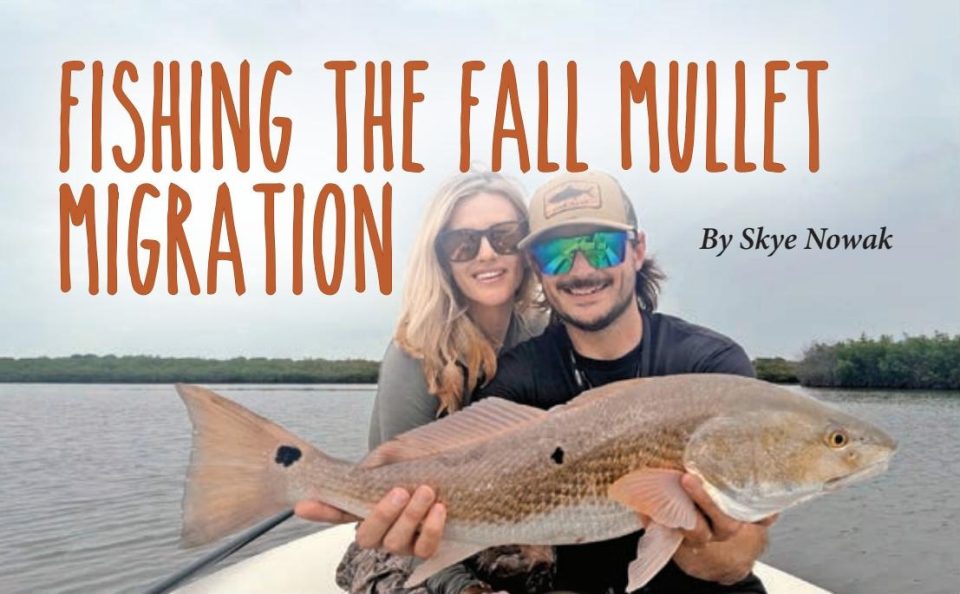
By Skye Nowak
The Atlantic coast of Florida experiences one of the planet’s greatest migrations each fall: the fall mullet run. When millions of mullet push south in giant schools toward spawning grounds off the southern end of the state, it presents an exciting prospect for fishing. It’s an event anglers anticipate all year long.
The mullet run doesn’t have an official start or end date. Large schools of mullet, some being the size of three football fields, move south as temperatures cool. Tarpon, sharks, kingfish and redfish are just some of the gamefish that move with these pods. Most years the fishing is on fire in the months of October and November.
Obviously, mullet is the bait to use this time of the year. I prefer freelining finger-sized mullet as pretty much everything will bite!
I mainly fish inshore, so light tackle is the way for me. However it is important to be prepared to switch up, depending on the size and species of the game fish present. In the backcountry, I like a light-action to medium-action 2000 size spinning setup to fish 10/15 pound leader to a 3/0 circle hook, using a simple loop knot, tying a FG knot or double uni to connect leader to braid (main lines) creating a true free line without the added weight of the swivel.
The rigging is pretty much the same if needed to beef up for larger catches. That being said, in a 2500 size setup I’ll fish 15/20 pound leader, but I’ll bump that up to 25/30 pound test on a 3000 size gear for bigger game fish. To fish with mullet, I simply follow the pods, casting to the outside of the schools, opening my bail to let the bait swim naturally. When you hit it right you’ll find yourself hooking up on nearly every cast. With species changing from one cast to the next. From snook to tarpon. Big gamefish tend to seek out isolated or injured mullet, which is exactly what your bait is.
This backcountry lady angler enjoys sight fishing and scouting the marshes from the Tomoka Basin to Mosquito Lagoon along Florida’s central Atlantic Coast. I’ll target large breeder reds in the inlets, however I spend my days chasing snook, reds, tarpon, black drum, and sighting tails in our estuaries and marshes. This style of fishing is perfect for throwing artificials on light tackle. This time of the year any artificial that resembles a mullet will produce: swimbaits, Rapala X-Raps, Bomber Lures, Savage Gear Pulse Tail Mullets, LIVETARGET Slow-Roll Mullets, MirrOlure Suspending Twitch Bait Mullets and, my “go-tos,” the NLBN 3-3.75 paddletail jigs, K-Tails and 4-inch to 7-inch mullets. (You can never go wrong with a good ol’ fashioned spoon!)
Please remember that during the fall mullet run our breeder redfish are much more susceptible to being caught from beaches, boats, bridges, docks and piers. Handling them with care and releasing them safely is important to the future of our fisheries! The statewide slot limit is 18-27 inches, intended to protect the larger fish which are part of the spawning stock. Landing a larger redfish this time of the year is easy with the mullet running simply freelined or drop one on a weighted rig to land that trophy! Before you experience that drag-pulling run you should be knowledgeable on how to properly handle and release your fish.
In recent years, Florida has adopted management plans for redfish and there are new regulations across nine different zones. Anglers need to understand these regulations because they are intended to protect one of our iconic species in the face of habitat loss. Most of the state now has a one fish per person daily limit in the 18-27 inch slot. Some regions have two fish per vessel limit and others have a four fish per vessel limit. The Indian River zone, from New Smyrna Beach South Causeway to the Martin/Palm Beach County line (not including Loxahatchee), is strictly catch-and-release only for redfish. Make sure to visit myfwc.com for your area’s regulations, as well as instruction on safe handling and release.