


By Jiggin’ Jerry, Contributing Writer
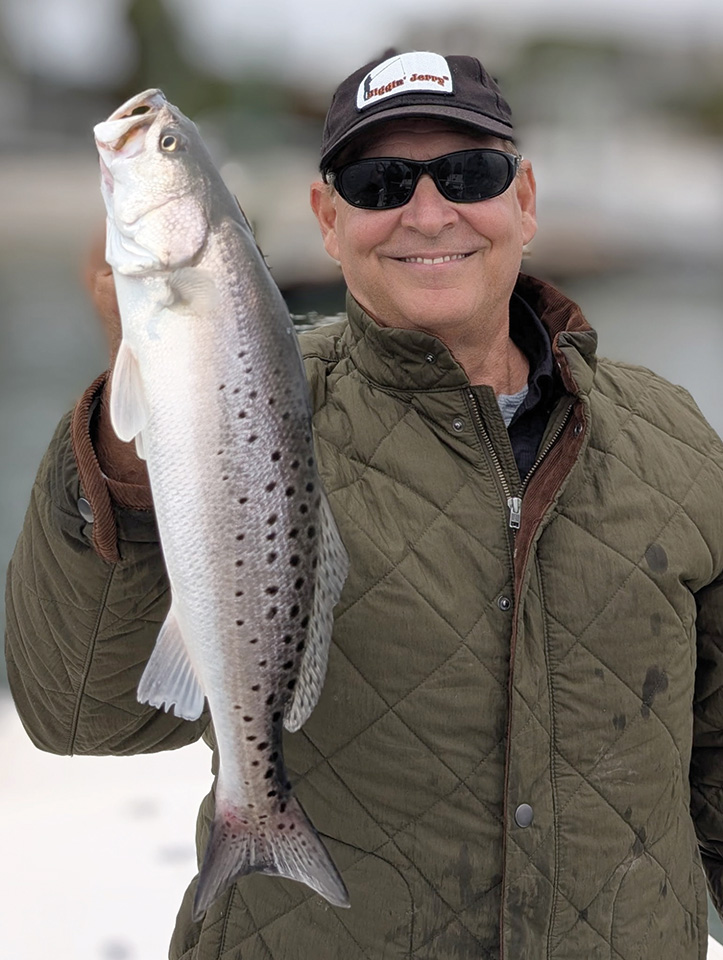
Spotted Seatrout can be caught year round here in the Lowcountry. The difference in catching them through different seasons are the techniques used. If you are using artificials to target Spotted Seatrout, there are a number of different types. There are hard baits like fast moving rattlers, top water jerk baits and poppers, slow descending and fast descending. These hard baits can look like live Shrimp, Finger Mullet, Mud Minnows, Shad and Menhaden, etc. Other popular artificial baits are soft plastics. These plastics usually imitate Shrimp, small bait fish, like Mud Minnows, Glass Minnows and Finger Mullet. Some don’t look like anything that mimics a recognizable live bait. These shapes like curly tail grubs, Trout tricks, tube baits, etc.
All the baits are used by casting in different retrieval techniques that involve moving your rod as if you were a puppet master and your bait the puppet. The objective is to make the baits look and act in the same manners with the same movements as if they were real. This involves a lot of different techniques. The technique would be applied to each different bait. Let’s look at a paddle tail bait, for instance.
You can use different weighted jig heads with your paddle tail bait. Lighter jig heads are usually used for calmer or shallow water and over structure. The lighter weight allows you to control the descent of your paddle tail grub, making it move and dance by either allowing it to drop and twitching your rod, popping your bait back up towards the top of the water, then allowing it to descend again. As you repeat the motion, you reel in the slack line. This brings your bait back towards you, and when you feel as though the bait is no longer in the strike zone, you quickly retrieve your bait and recast. That is considered a technique. So what technique would help you catch more Trout in the winter?
The first thing we need to look at is how do Trout act in the winter and what are their habits? Large groups of male Trout like to congregate in creeks, river bends and alongside oyster beds that have a deeper hole of water. If you are moving down a body of water, and the water depth is averaging between five and nine feet, and you come up on a location that has a deeper hole of water, around 14 feet deep, and has structure or even a grass bank neighboring the location, that would be a great spot for Spotted Seatrout to be schooling. The technique used to target them can be done with artificials or live bait.
Live Shrimp through the months of December, January and February work great. A lot of individuals will just tie on a popping cork with only a few feet of leader line and fish along the surface or grass line. This technique will get you some Trout here and there that are feeding along the upper water column, and if you don’t find the Trout, you most likely will find a large number of Bluefish that will happily try to eat all of your Shrimp.
The goal is to get your bait, live or artificial, to the bottom. This can be done with weighted Carolina rigs and weighted jig heads. Once it reaches the bottom, you want to drag your bait forward slowly along the bottom, then a nice calm slow raise a few feet off the bottom, then drop your rod tip down and allow the bait to descend back to the bottom. Repeat the motion over and over because this time of year Trout are moving and feeding slow. The water is cold and so are the Trout. Unless they are in the shallows on a bright sunny day, they need these deeper holes for the warmer water, and this is why the Trout act the way they do through our winter months here in the Lowcountry, and if you are in the right location at the right time, you may start catching one after another or even hook into a couple of nice big females. This technique works with most weighted rigs and weighted artificials. I personally accomplish this technique with jig heads weighing from a simple weight of 1/8 ounce to 1/4 ounce.
So if you can stand the chill in the air and you feel like getting out on the water and catching some of these exciting fish, this little bit of information may point you in the right direction. Like I always say, good luck out there and have fun fishing! To view some fishing adventures, go to my YouTube Channel Fishing With Jiggin Jerry or follow me on Facebook @fwjigginjerry.